What triggers a recount? In most states a candidate or voter may request one when the margin falls inside a statutory threshold — commonly 0.5 percent of the votes cast in the race, with narrower bands (0.25 or 0.35 percent in several states) determining who pays — while a handful of states including Alaska, Colorado, Connecticut, Hawaii and Oregon recount automatically whenever a race lands within their margin, whatever anyone requests. The trigger is a matter of state law, and every threshold, payer and deadline differs; the count is governed by rules written before the election, not argued into existence after it.
What are the basic trigger designs?
- Automatic recounts: the canvass itself starts the recount once the margin qualifies — no request needed, as in Pennsylvania's 0.5-percent law and Georgia's ≤0.5-percent rule enacted in 2020.
- Requested recounts with threshold: candidates petition within a short window (often 3–7 days after certification) if inside the margin; Wisconsin is the archetype — within 1 point, free to the requester inside 0.25 percent.
- Requested recounts without threshold: any margin, at the requester's cost — the Florida 2000 and some modern congressional recounts ran this way, with deposits forfeited if the result holds.
What gets counted — and examined — in a recount?
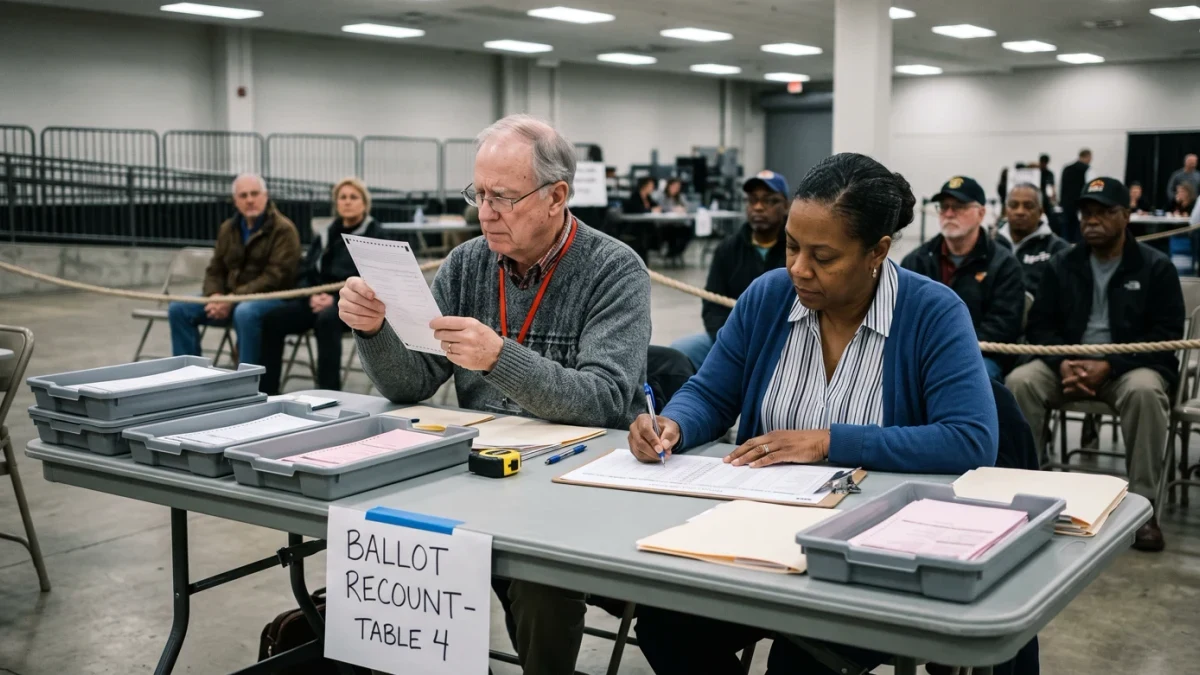
Two different activities share the name. A machine recount re-feeds ballots through tabulators: fast, cheap, and typically moving totals by handfuls of votes. A manual recount or audit has humans examining ballots: overvotes, undervotes, marginal marks, and — where law permits — «voter intent» standards that let officials count ambiguous marks. Some states' recounts combine both: machine first, manual for disputed batches. Evidence-based reviews after the 2020 machine recounts found shifts of a few hundred votes at most in million-vote races — the empirical baseline for what a recount can change.
What is the canvass's role?
Recounts run after the canvass, not off election-night numbers. The canvass — the local boards' official certification of results — resolves provisional ballots, cured mail ballots and reporting errors first; only the certified margin determines whether a threshold is met. This sequencing produces the recurring election-week pattern: an election-night «margin» inside 0.5 percent may drift outside it (or further inside) by certification, and the recount question is decided by the final, certified count.
Where do courts come in?
Litigation accompanies recounts in three standard postures: disputes over ballot validity standards applied during the recount (the Bush v. Gore equal-protection issue); challenges to recount procedures themselves; and contests — separate proceedings where a losing candidate alleges illegal votes or errors and asks the court or legislature to seat them instead. Timing rules bite hard: contest filing deadlines are typically days after certification, and federal safe-harbor timing under the Electoral Count Reform Act now fixes short, explicit timelines in presidential disputes, per the statute's text.
What should 2026 watchers know?
That margins decide machinery. A race inside 0.5 percent in a threshold state enters a scripted sequence — certification, request window, recount, possible contest — with dates set in advance. Races outside the threshold in requester-pays states can still be recounted by a paying candidate. And in the closest contests, the decisive question is usually which ballots were in the universe to be recounted: late-cured mail ballots, provisional counts, and undervote adjudication matter more than the recount's arithmetic.
FAQ
Which states recount every close race automatically?
A small set including Alaska, Colorado, Connecticut, Hawaii and Oregon, plus Pennsylvania and Georgia within their thresholds; most others require a request.
Who pays for a recount?
The state when automatic or inside the free-request band; the requester otherwise, with costs sometimes refunded if the outcome flips.
How much do recounts usually change?
Typically fractions of a percent — a few hundred votes per million cast, per post-recount reviews of recent cycles.