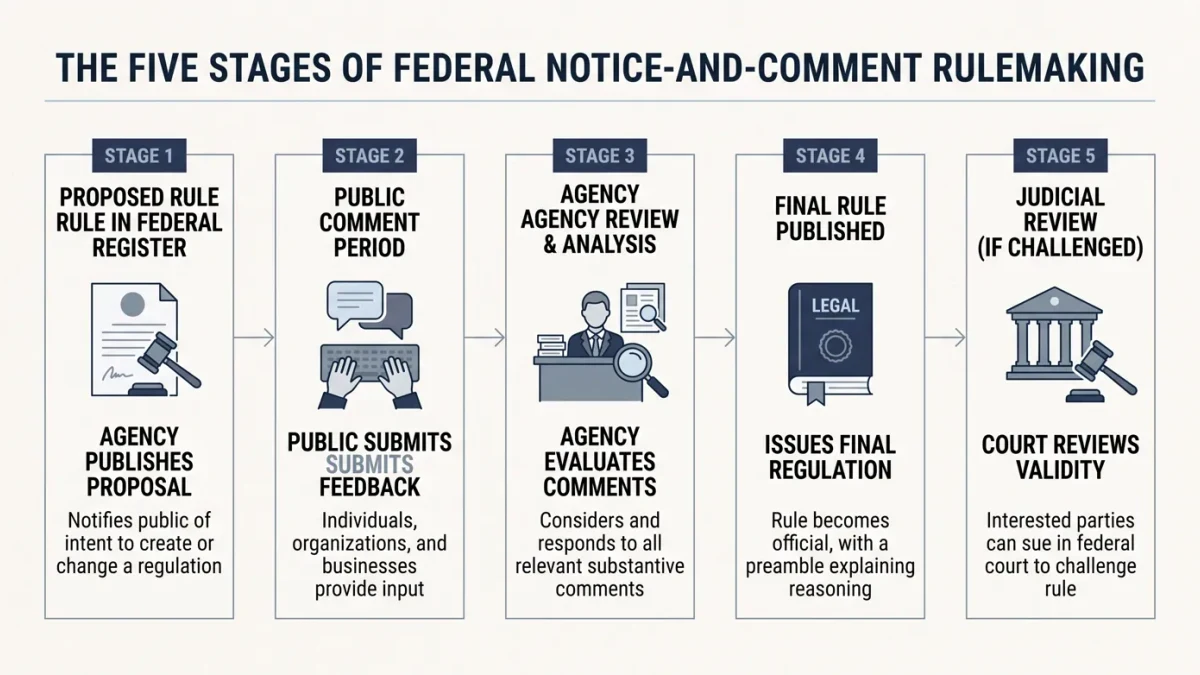
How does a federal regulation come into force? An agency publishes a proposed rule in the Federal Register, opens a public comment period — typically 30 to 60 days — must consider and respond to significant comments, then publishes the final rule with an effective date at least 30 days later, all under the Administrative Procedure Act of 1946, 5 U.S.C. § 553. The Federal Register publishes thousands of documents a year; agencies finalize several thousand rules annually, of which a few hundred are «significant» enough to require Office of Information and Regulatory Affairs review, per the Office of the Federal Register's own statistics.
What comes before the proposal?
Agencies usually publish an Advance Notice of Proposed Rulemaking — an open question to the public — or advance directly to a Notice of Proposed Rulemaking (NPRM). For economically significant rules (impact above $200 million annually under the current threshold), the agency must send the draft to OIRA inside the Office of Management and Budget, which has up to 90 days to review, meeting with outside parties whose attendance OIRA logs publicly. Only after that review does the proposal hit the Federal Register.
What can a public comment actually do?
Two things, one visible and one legal. Visibly, agencies revise rules between proposal and final in response to comments — changed thresholds, delayed compliance dates, carved-out industries. Legally, the APA requires the final rule to rest on a reasoned basis: under State Farm v. Motor Vehicle Manufacturers (1983) and Encino Motorcars v. Navarro (2016), an agency changing course must explain the change, and a final rule that fails to address significant comments is vulnerable to being set aside as «arbitrary and capricious.» Mass form-letter campaigns rarely move rules; a single well-evidenced comment with data often does.
What are the fast lanes and detours?
- Direct final rules: used for uncontroversial technical changes — effective unless an adverse comment arrives.
- Interim final rules: effective immediately with comments after the fact, invoked when agencies find «good cause» to skip pre-publication comment — heavily used in emergencies, including 2020 pandemic rulemaking.
- Emergency and temporary rules: statutory authority varies; each carries its own judicial review exposure.
How do rules get challenged?
Final rules are reviewable in federal courts of appeals, usually by petition within 60 days, and venue statutes send most challenges to the D.C. Circuit or to courts where the challenger resides. Judges ask whether the rule is within statutory authority (Chevron deference is gone — the Court overruled it in Loper Bright v. Raimondo in 2024, restoring independent judicial interpretation of statutes), whether it was procedurally sound, and whether the explanation holds up. A vacated rule returns the law to its prior state unless the court severs or stays.
How can a new administration unwind a rule?
Through the same pipeline in reverse: a new proposal to repeal or amend, comment period, final action — or, faster, the Congressional Review Act, which lets Congress disapprove a rule within roughly 60 Senate-session days of its submission, after which the rule is dead and cannot be reissued in substantially similar form. Every administration since 2017 has used both tools; the CRA had been used successfully dozens of times in 2017 alone.
FAQ
Where do I find open comment periods?
Regulations.gov lists every open docket by agency and deadline; the Federal Register's daily edition publishes each NPRM with instructions.
Do agencies have to reply to every comment?
To significant ones: the final rule's preamble must respond to relevant comments that raise significant issues; form letters can be answered collectively.
What kills a rule in court most often?
Failure to explain a change from the proposal, inadequate responses to comments, or statutory authority problems after Loper Bright.