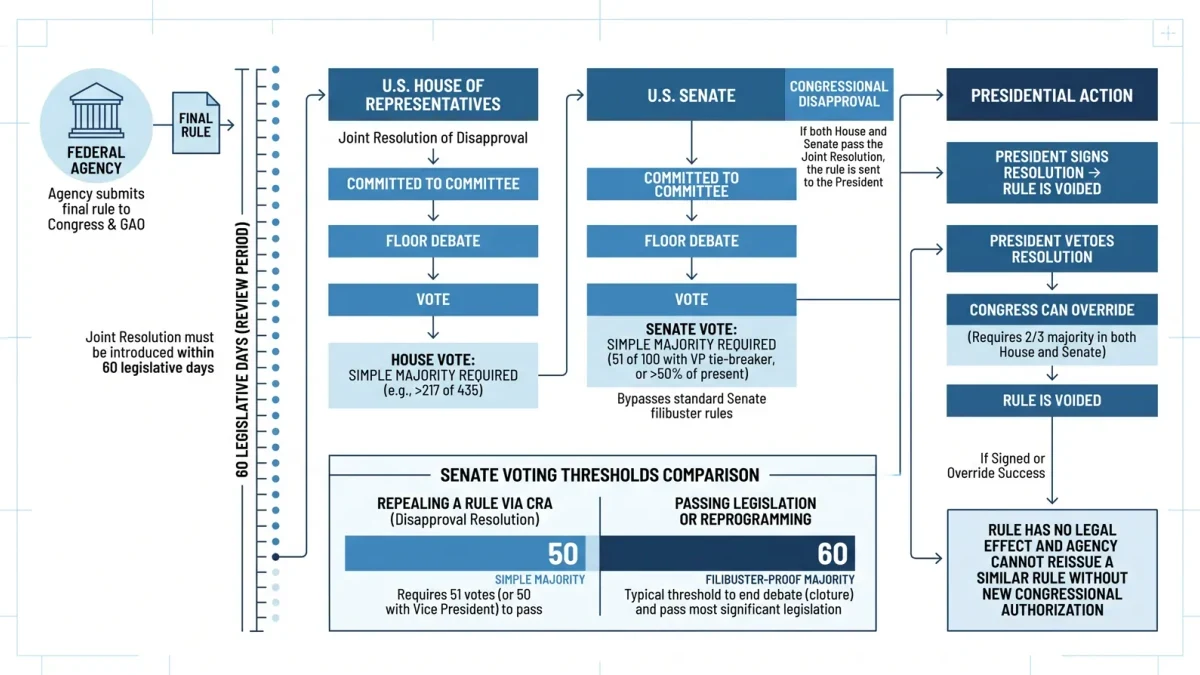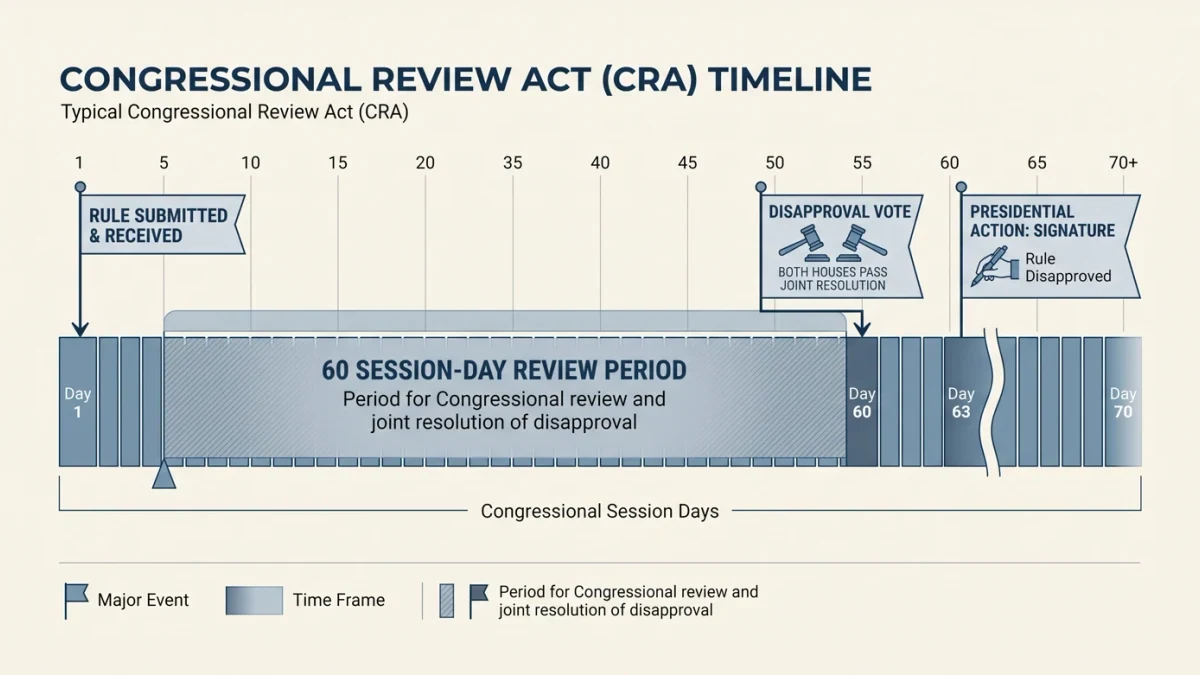
How can Congress cancel a federal regulation? Under the Congressional Review Act of 1996, 5 U.S.C. §§ 801–808, Congress may pass a joint resolution of disapproval voiding any rule submitted to Congress in the previous 60 Senate-session days, and that resolution is exempt from the Senate filibuster — debate capped, no amendments, simple majority. If the president signs, the rule «shall have no effect,» and the agency may not reissue it in substantially the same form without specific statutory authorization. Roughly 20 rules were disapproved in the CRA's first two decades — then a single 2017 window erased 16 Obama-era rules, and disapprovals have recurred with each change of party control, per congressional records.
How does the clock actually work?
Every final rule must be submitted to both chambers with a report; the review period is counted in days of continuous congressional session, not calendar days — meaning a rule submitted in May can still be vulnerable in January, because the 60 «session days» accumulate slowly across recesses. Rules submitted late in a Congress get a fresh window: the lookback provision restarts the clock in the next Congress, so rules finalized in the last months of an outgoing administration remain reviewable by its successor's Congress. That lookback is how the 2017 batch — and comparable batches after later transitions — became possible.
What can a CRA resolution reach?
«Rules» as defined by the APA — including rules not normally published, guidance with practical effect (after the GAO's expanded reading), and even some rules agencies never reported, which remain subject to review indefinitely if unreported. Major rules cannot take effect until the review period runs. What CRA cannot reach: statutes, treaties, and executive orders that are not rules; and its disapprovals cannot touch a rule's underlying statutory mandate — the agency usually must try again by different means.
Why the CRA beats the normal rulemaking repeal
- Speed: one up-or-down resolution versus a multi-month notice-and-comment repeal that can itself be litigated for unexplained reversals.
- Filibuster immunity: Senate debate limits are built into the statute.
- Precedential bite: the «substantially similar» bar legally forecloses a quick reissue.
What are the limits in practice?
Presidential politics dominate: a resolution needs the president's signature or a two-thirds override, so disapprovals overwhelmingly occur when a new Congress faces rules issued by the other party's outgoing administration. Congress also cannot amend through the CRA — it is repeal or nothing, forcing choices between accepting imperfect rules and losing entire programs. And because each resolution consumes floor time, leaders bundle the politically safest targets; the backlog of reviewable rules always exceeds what Congress will actually vote on.
What is the «substantially similar» bar?
The statute does not define it, and there is little case law; agencies and OIRA lawyers treat it as a serious constraint on reissuing a disapproved rule without new statutory authority. Watchers of early-2026 rulemaking — a transition period again populated by late-submitted rules — should expect the question to recur: how close to a disapproved rule can a new rule come? The honest answer is that Congress, not the courts, has mostly policed that line, by granting or withholding specific authority.
FAQ
Can the CRA be filibustered in the Senate?
No — the act caps debate and prohibits amendments, so a simple majority suffices once the resolution reaches the floor.
What is the lookback provision?
Late-session rules carry over: the review window restarts in the following Congress, keeping outgoing administrations' rules reviewable.
Does disapproval require the president's signature?
Yes, absent a two-thirds override — which is why CRA successes cluster at party-change transitions.