What is OIRA review? The Office of Information and Regulatory Affairs — roughly 50 career analysts inside the Office of Management and Budget — reviews agencies' draft significant regulations before publication, checking their cost-benefit analyses under executive orders that have governed regulatory review since 1981, currently Executive Order 12866 as amended. In a typical year OIRA reviews several hundred rules, of which several dozen are «economically significant» — defined as $200 million or more in annual economic effect under the current threshold — and each such rule must arrive with a full Regulatory Impact Analysis whose figures are auditable, public, and litigable.
How does the cost-benefit arithmetic work?
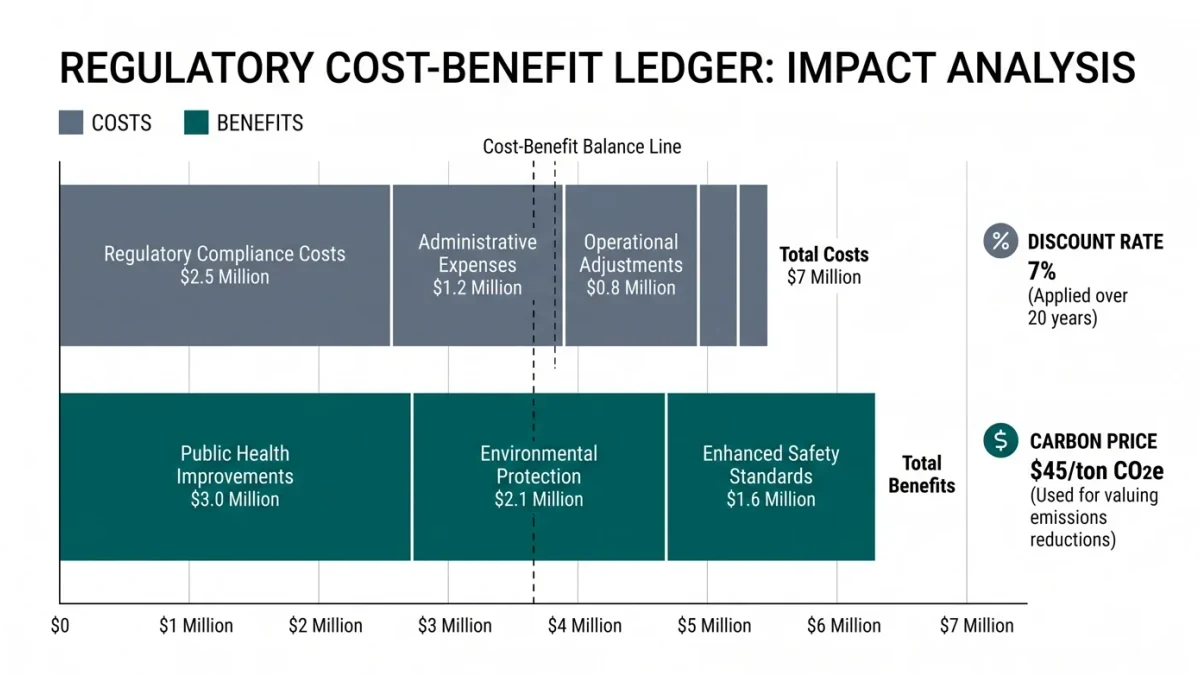
Agencies monetize expected benefits and costs over a time horizon, discount future values to present terms, and compare alternatives. The most consequential single input is the «value of a statistical life» — the monetary value agencies assign to mortality-risk reductions, set in the millions of dollars per expected death averted and updated over the years, which alone can swing a rule's net benefit by billions. Other loaded inputs: the social cost of carbon used for climate rules, wage values for time saved in transportation rules, and compliance-cost surveys from affected industries.
Where can the public see it?
At three checkpoints. Draft rules enter OIRA review and appear on the office's public «reg review» dashboard with dates, return dates, and meetings held. Final rules publish in the Federal Register with their full analyses attached or incorporated by reference. And each year OIRA reports to Congress on the aggregate benefits and costs of federal regulation — reports that consistently show estimated benefits exceeding costs, driven by a handful of air-quality rules whose benefit estimates dwarf everything else.
Why do the numbers end up in court?
Because they are the record. A challenger arguing a rule is arbitrary and capricious attacks the analysis: an unexplained change in discount rate, a benefit estimate unsupported by the studies cited, a cost estimate built on stale industry data. Courts have vacated or remanded rules on exactly these grounds across administrations. Business input therefore works best not through press releases but through the comment dockets and OIRA meeting memos — documents with legal weight in later review.
How have recent administrations changed the frame?
- Discount rates: Circular A-4, the government's guidance document on regulatory analysis, was updated in 2023 to recommend lower rates — raising the present value of long-horizon benefits like climate rules; a subsequent administration can and does revisit the guidance.
- Deregulatory accounting: executive orders since 2017 required agencies to count deregulatory actions and offset new regulatory costs — a budgeting concept layered on top of E.O. 12866's benefit-cost frame.
- Scope of «benefits»: fights over which effects count (e.g., climate co-benefits of air rules) recur with each transition.
What should a business actually do with this?
Three habits. Track OIRA's dashboard for rules pending in your sector — review dates signal what's coming and when. Read the Regulatory Impact Analysis, not the fact sheet: compliance dates, exemptions by firm size, and record-keeping mandates live in the analysis. And file substantive comments with data during the open comment period; post-promulgation challenges succeed mostly where the commenter built a record first.
Political Digest publishes information, not investment or legal advice.
FAQ
What makes a rule «economically significant»?
An annual economic effect of $200 million or more, or novel legal/policy issues — triggering OIRA review and a full Regulatory Impact Analysis.
Can OIRA kill a rule?
It can return a draft to the agency for reconsideration — publicly logged — though the formal decision remains the agency's under its statute.
Where are OIRA meetings disclosed?
On OIRA's website: dates, attendees and subject rules for every outside meeting during review.