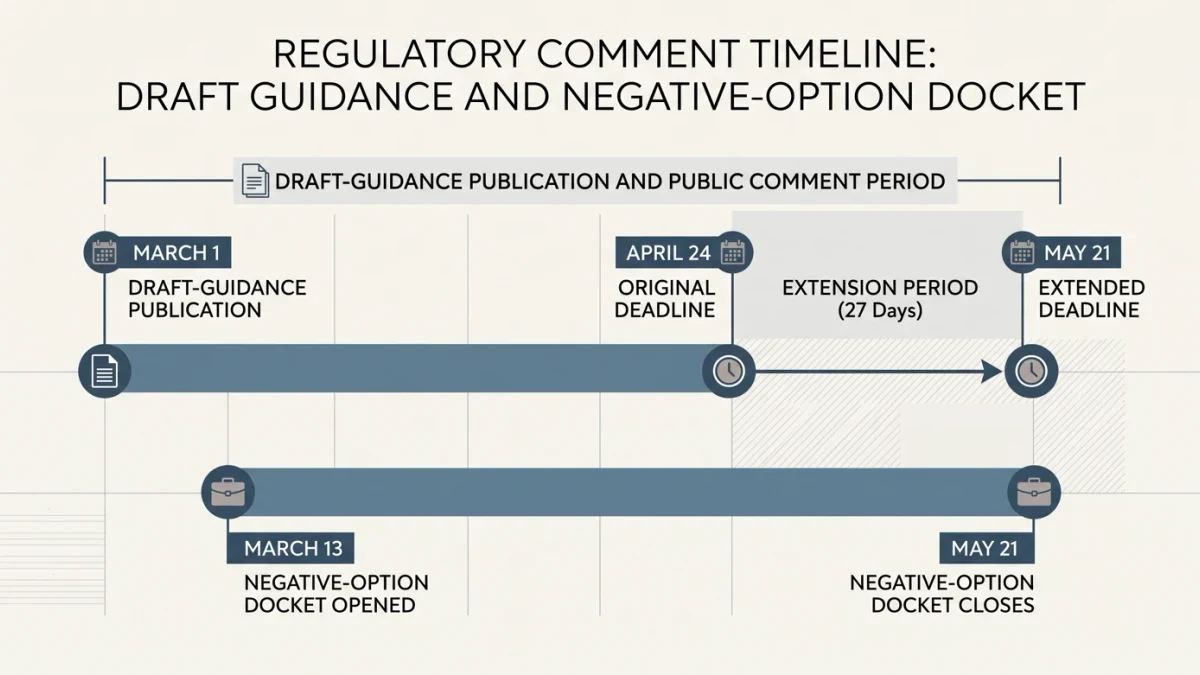
The Federal Trade Commission and the Justice Department's Antitrust Division extended the public comment deadline on their draft guidance for business collaborations from April 24 to May 21, 2026, according to the agencies' April announcement. The guidance, when final, will tell companies how the enforcers evaluate joint ventures, information sharing, and other competitor collaborations — the everyday architecture of strategic alliances in pharmaceuticals, semiconductors, logistics, and tech standard-setting.
Why competitor-collaboration guidance matters
Antitrust condemns agreements among competitors that fix prices or divide markets — per se violations under Section 1 of the Sherman Act — but permits many cooperative arrangements judged under the rule of reason: production joint ventures, R&D partnerships, benchmarking exchanges, and buying cooperatives among them. Guidance documents do not carry the force of law, but they anchor enforcement discretion, merger discussions, and safe-harbor planning; businesses and their counsel negotiate against them for years. The 2026 draft replaces prior frameworks with whatever reading the agencies give competitiveness and labor-market effects in collaborative arrangements, which is why the comment extension drew trade associations' relief.
What a comment extension signals
Extensions are granted when substantive input is coming — an indication that organized industry feedback arrived in volume during the original window. Under the agencies' own practice, significant comments must be answered in the final guidance or, for rules, the final rule's record; comments filed with data and specific drafting proposals tend to be the ones that move text.
Separately: subscription billing rule docket
Also open this spring is the FTC's proposed rule on prenotification negative-option plans, published in the Federal Register on March 13, 2026 — the latest step in the Commission's years-long effort to tighten subscription and recurring-billing practices, with the comment docket running on the Federal Register's published schedule. Businesses with recurring-revenue models should read both dockets together: collaboration guidance governs who may work together; the negative-option rule governs how they may charge.
The procedural consequence
Neither document changes obligations today. The comment window runs to May 21 for the collaboration guidance; the negative-option proposal awaits finalization after its docket closes. The compliance-relevant dates are the Federal Register's, and the comments themselves — public on Regulations.gov — are the best early indicator of where the final texts will land.
Political Digest publishes information, not legal advice.
FAQ
What are business collaborations in antitrust terms?
Arrangements where competitors cooperate short of merger — joint ventures, data-sharing consortia, co-production agreements — evaluated under rule-of-reason or per se standards.
Do guidance documents bind courts?
No; they guide enforcement priorities and negotiation posture, but judges apply the statutes and precedent independently.
Where can comments be read?
On the dockets at Regulations.gov and the agencies' press-release pages, where the FTC and DOJ posted the extension notice.