What is qualified immunity? It is a judge-made doctrine holding that government officials — most contentiously, police officers — cannot be sued for money damages for constitutional violations unless the right was «clearly established» at the time: a plaintiff must point to existing precedent in which similar conduct was held unlawful, in a closely comparable factual setting. The Supreme Court announced the modern framework in Harlow v. Fitzgerald (1982), replacing a subjective good-faith test with an objective one to protect officials from litigation costs, per the opinion itself. It is a defense to damages, not to injunctive relief or criminal prosecution.
Political Digest publishes information, not legal advice.
How does the two-step analysis run?
Courts ask, in any order: did the official violate a constitutional right, and was the right clearly established? The «clearly established» prong demands specificity — «beyond debate,» as the Court put it in Ashcroft v. al-Kidd (2011). A rule can be violated without recovery if no prior case put the unlawfulness beyond debate, which is why the doctrine's critics call it «Heads I win, tails you lose»: every new fact pattern defeats the very precedent that would have established it. Defenders answer that the specificity requirement protects officials who must make split-second decisions, and that damages deterrence is meant to run against government entities, which Monell v. Department of Social Services (1978) made suitable for policy-based violations without any individual immunity defense.
What is the critique-and-reform terrain?
- Judicial: several justices — across ideological lines — have invited reconsideration of the «clearly established» specificity, in dissents from denial of certiorari; the Court has so far declined.
- Legislative: the George Floyd Justice in Policing Act's qualified-immunity provisions stalled in the Senate in 2021; states have acted unilaterally.
- State workarounds: Colorado (2020), New Mexico (2021), New York City locally and others created state-law causes of action without a qualified-immunity defense — bypassing rather than amending the federal doctrine.
- Section 1983 itself unchanged: the statute says nothing about immunity; it is entirely judicial construction.
How does it interact with Bivens?
Bivens v. Six Unknown Named Agents (1971) implied a damages remedy for some federal constitutional violations. The modern Court has confined Bivens nearly to its facts — Ziglar v. Abbasi (2017) and Egbert v. Boule (2022) refused to extend it — so for federal officials, the question is less immunity than whether any damages remedy exists to be immune from. State and local officers, sued under 42 U.S.C. § 1983, remain qualified immunity's main arena.
What happens procedurally in a case?
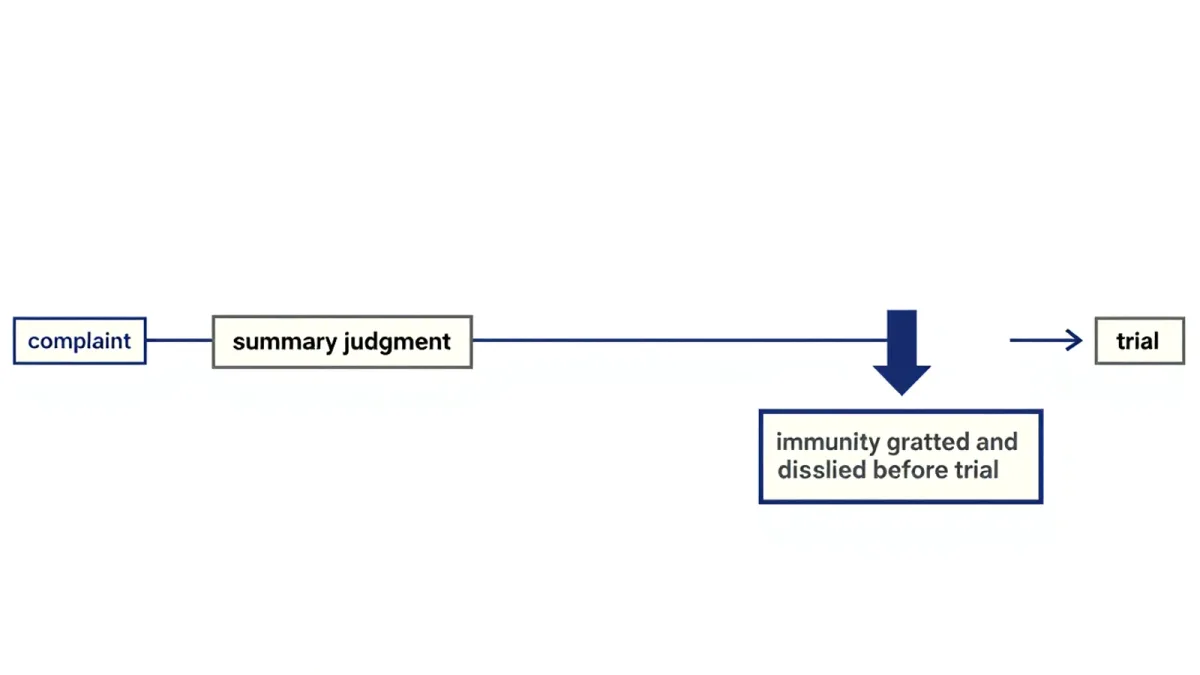
Qualified immunity is raised early, ideally before discovery: the doctrine entitles officials to dismissal at the pleading stage or on summary judgment when the right was not clearly established. Interlocutory appeal follows — the Mitchell v. Forsyth line permits immediate appeal of denials — which is why these cases generate years of procedure before merits discovery. That sequencing is itself a policy argument: plaintiffs' bar calls it the toll of never reaching trial; the defense bar calls it the doctrine working.
FAQ
Does qualified immunity protect officials from prosecution?
No — it is a civil damages defense only; criminal liability is unaffected.
Can officials be sued at all?
Yes: for injunctive relief, and for damages where a closely matching precedent clearly established the right; governments can also be sued under Monell.
Which states removed it?
Colorado and New Mexico enacted state causes of action without the defense; several jurisdictions limited it by statute or local ordinance.