What can a presidential pardon do? Article II, section 2 gives the president «power to grant reprieves and pardons for offenses against the United States, except in cases of impeachment» — federal crimes only, unlimited in number, available before charges are filed (as Ex parte Garland held in 1866), and effectively unreviewable by courts, as the Court reaffirmed in Trump v. United States (2024) in describing the power's core. What it cannot do: touch state prosecutions (a state governor's domain), undo impeachment, restore a lost office, or — per the founding debates and consistent practice — pardon itself, a question the Constitution's text leaves and scholars contest without a definitive court answer.
Political Digest publishes information, not legal advice.
How the regular process runs
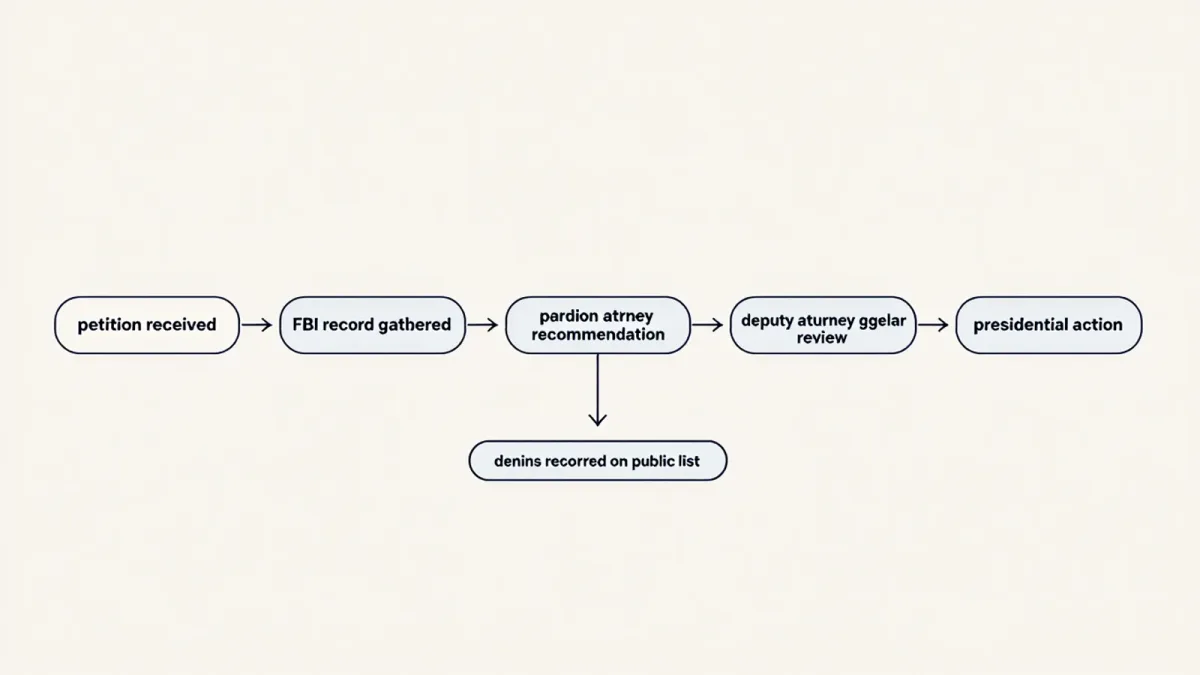
Almost all pardons travel through the Office of the Pardon Attorney at the Justice Department: a petition, FBI background review, publication of a notice in the Federal Register for public comment (required since 2022's rule change for do-it-yourself petitioners), and a recommendation to the president. Commutations — shortening sentences without forgiving the conviction — follow the same channel, with heavy weight on the U.S. Attorney and the sentencing judge's input. The process takes years; its output is the pardon the public never hears about.
What the clemency types are
- Full pardon: forgives the offense and restores civil rights lost on conviction (firearms restrictions have statutory caveats).
- Conditional pardon: forgiveness subject to conditions — enforceable, and revocable on breach, per Schick v. Reed (1974).
- Commutation: reduces a sentence, leaving the conviction standing.
- Remission and respite: niche forms — returning fines and forfeitures, postponing sentences.
Where the unwritten rules live
The binding text is one sentence; everything else is practice that shifts between administrations. Waiting periods (typically five years after release before a pardon petition), the «acceptance» requirement (Burdick v. United States, 1915 — a tendered pardon may be refused, and acceptance implies guilt in the case's reasoning), the custom of processing through the Pardon Attorney rather than around it, and the pattern of end-of-term clemency waves: each is policy, not law, and each recent administration has adjusted the mix — sentence-commutation initiatives, categorical pardons, and direct grants announced on social media have all entered the toolkit since 2014, per Department of Justice clemency statistics.
What courts will and will not decide
Courts construe pardons when enforcement follows — scope disputes (does this pardon cover this conduct?), conditional-pardon enforcement, and state-court questions of collateral effect. But the grant itself is not judicially reviewable for motive or wisdom: no court has ever vacated a pardon on the merits of the president's judgment, which is the power's defining feature and its recurring controversy — the same unreviewability that protects deserving grants protects abusive ones, with impeachment the Constitution's only check.
FAQ
Can a pardon cover future crimes?
No — only offenses already committed, though charges need not yet have been filed.
Does a pardon clear a state conviction?
No — it reaches federal offenses only; state relief requires the governor or state board.
Can a pardon be refused?
Yes — under Burdick, acceptance is the recipient's choice.