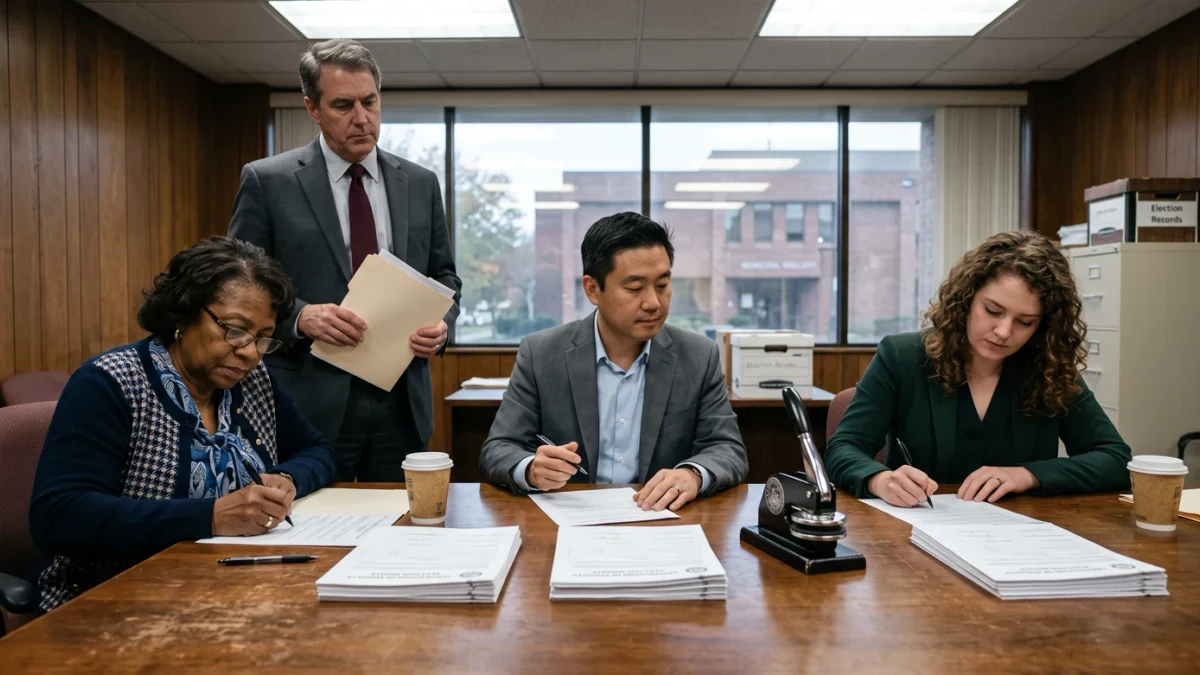
Where is election litigation concentrated now? Not on counting machines but on certification — the ministerial act by which county boards and state officials make results official. Since 2020, litigation and administrative proceedings have tested whether a local canvassing board may decline to certify results it doubts (New Mexico's 2022 Otero County episode, resolved by a court order compelling certification), whether state officials can withhold certification over audit demands (Georgia's 2024 state board proceedings), and what remedies exist when a board simply refuses. The consistent judicial answer — certification is a ministerial duty, not a discretionary review — now runs through orders from multiple states, but the statutory gaps that made the fights possible are being rewritten in both directions.
Three legal fronts
- Ministerial-duty suits: courts ordering boards to certify, mandamus actions naming individual officials, and state attorney-general interventions — the fast track that resolved the 2022 refusals within days.
- Rule changes: state boards and legislatures adjusting certification deadlines, audit sequencing, and the standards for board members' objections; Georgia's 2024 controversy over state election-board rules drew both legislative reaction and litigation.
- ECRA overlay: for presidential electors, the 2022 federal reform's governor-certification chain and expedited three-judge review now give disputed certifications a federal lane with short deadlines.
What the cases have established
Across party lines in the issuing courts, the holdings converge: local boards certify what the count shows; objections go through the recount and contest procedures each state already provides; and refusal exposes officials to court order and, in some states, removal or criminal exposure. The 2024 cycle ran largely on that settled understanding — certification disputes resolved quickly in the several counties where they arose — which supporters of the system cite as evidence it held, and critics of the refusals cite as proof the pressure campaigns continue where law is thinnest.
Why the board room matters more than the courtroom
Because that is where the law runs out. A court can order certification, but the order takes days; if refusals multiplied across counties in one state simultaneously, the statutory certification deadline — fixed before courts open — could pass into litigation no one has scripted. The 2020-era reforms addressed Congress's count; the county-level choke point has thinner statutory armor, which is why both national parties now train and lawyer-up for certification season, and why secretary-of-state offices publish certification manuals with counsel on call.
What 2026 tests
The midterm certification cycle will run under the newest statutes: states have adjusted deadlines and procedures each year since 2020. The questions to watch are procedural and specific — can a board obtain judicial review before its deadline, does the state have a fast removal mechanism, and does the ECRA lane capture any dispute that touches presidential electors four years from now. The system's resilience, this cycle will show, lives in the boring documents: canvass manuals, deadlines, and the phone tree between county counsel and the capital.
FAQ
Is certification discretionary?
No — courts in multiple states have held it ministerial, with objections channeled into recounts and contests.
What happened in Otero County?
A New Mexico county board refused to certify 2022 primary results over undisclosed concerns; a state court ordered certification, which followed.
What does the ECRA add?
A federal chain — governor certification with expedited three-judge review — for presidential elector disputes, alongside existing state procedures.