Why do primaries keep moving earlier? Because relevance is scarce and states compete for it: earlier contests receive more candidate attention, media coverage, and policy attention — Iowa and New Hampshire's first-in-the-nation status translates directly into retail-politics investment every four years — so states keep advancing their dates to escape the irrelevant late-March slot, a dynamic political scientists named «frontloading» decades ago and that has compressed the effective nominating window from spring to January-through-March. The brake is party law: both national parties' rules committees assign delegate penalties to states that jump their windows, which is why calendar fights are negotiated between state legislatures and the DNC/RBC and the RNC's rules committee each cycle.
What the 2024 turbulence showed
The 2024 calendar rewrote the Democrats' old order — South Carolina moved first by DNC design, citing diverse-electorate arguments after Biden's 2020 coalition analysis; New Hampshire defied the new calendar under its own state law protecting its first-in-the-nation statute and was sanctioned; Michigan and Georgia's positions were contested between the parties. The procedural lesson: state statutes and party rules are separate law, and when they collide, the party's only weapon is delegate seating — a penalty committees have both imposed and waived depending on the politics, per the rules committees' published decisions.
What frontloading does mechanically
- Compressed vetting: less time for scrutiny between contests — the practical argument reformers raise.
- Money's early lever: candidates must build name-ID and organization before Iowa rather than through it, advantaging well-funded and famous entrants.
- Big-state lockout: the largest states vote in a bloc where momentum is already decisive — the reason both parties have debated regional-primary plans since the 1990s without adopting them.
What midterm primaries show about the same forces
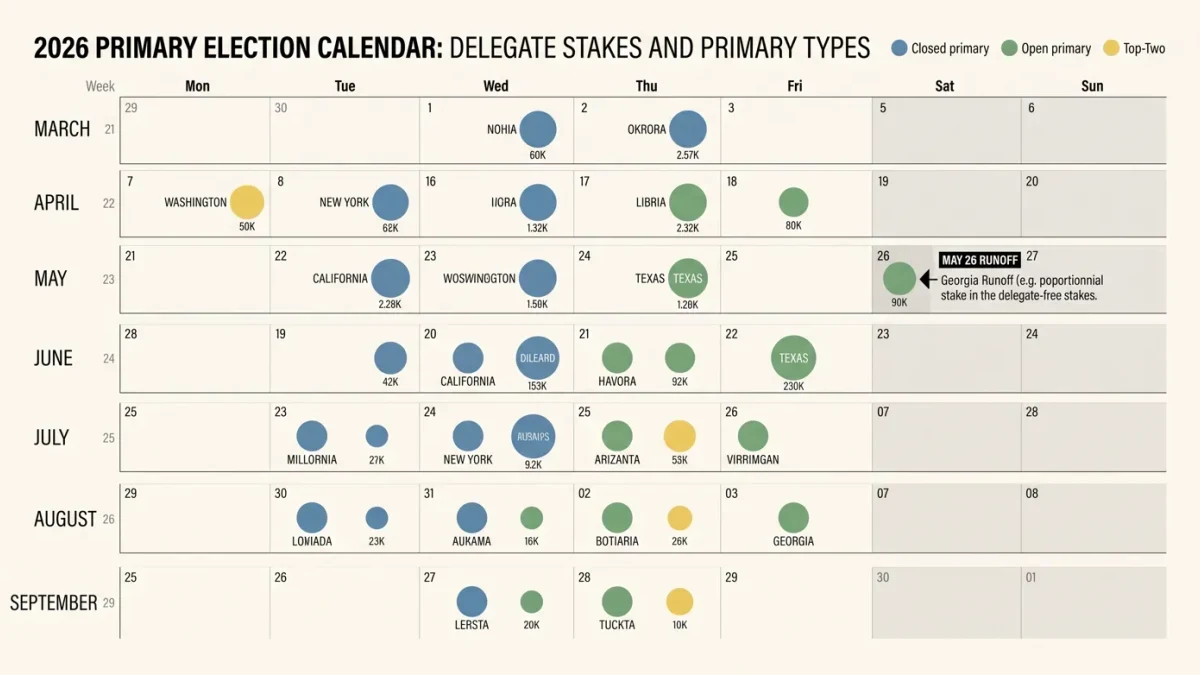
The 2026 calendar displays frontloading's state-level version: Illinois voting March 17, the May cluster absorbing Ohio, Indiana, Kentucky, Oregon, Pennsylvania and the June waves following — states balance early relevance against filing timelines, legislative session calendars, and the federal 45-day overseas-ballot clock for their generals. Where redistricting litigation is live, the tension bends the other way: states have delayed primaries to finalize maps, which is why filing deadlines are the true first domino of any cycle.
Can the calendar be reformed?
Proposals recur — regional primaries rotating by cycle, a single national primary (which would favor the best-known candidate outright), or party-ordered windows enforced by automatic penalties. None has overcome the coordination problem: every state prefers the current race to the front over a shared orderly queue, and the two parties' interests in any given cycle diverge. The 2028 order will be negotiated again from scratch, with Iowa and New Hampshire's claims contested once more by the same forces that reshaped 2024.
FAQ
What is frontloading?
The cumulative movement of primaries and caucuses toward the beginning of the calendar year as states compete for influence over the nominee.
Who controls primary dates?
State legislatures set the dates by statute; national parties police the calendar with delegate penalties under their rules.
What happened to New Hampshire in 2024?
It held its first-in-the-nation primary under state law despite the DNC's new calendar, and absorbed the party's sanction.