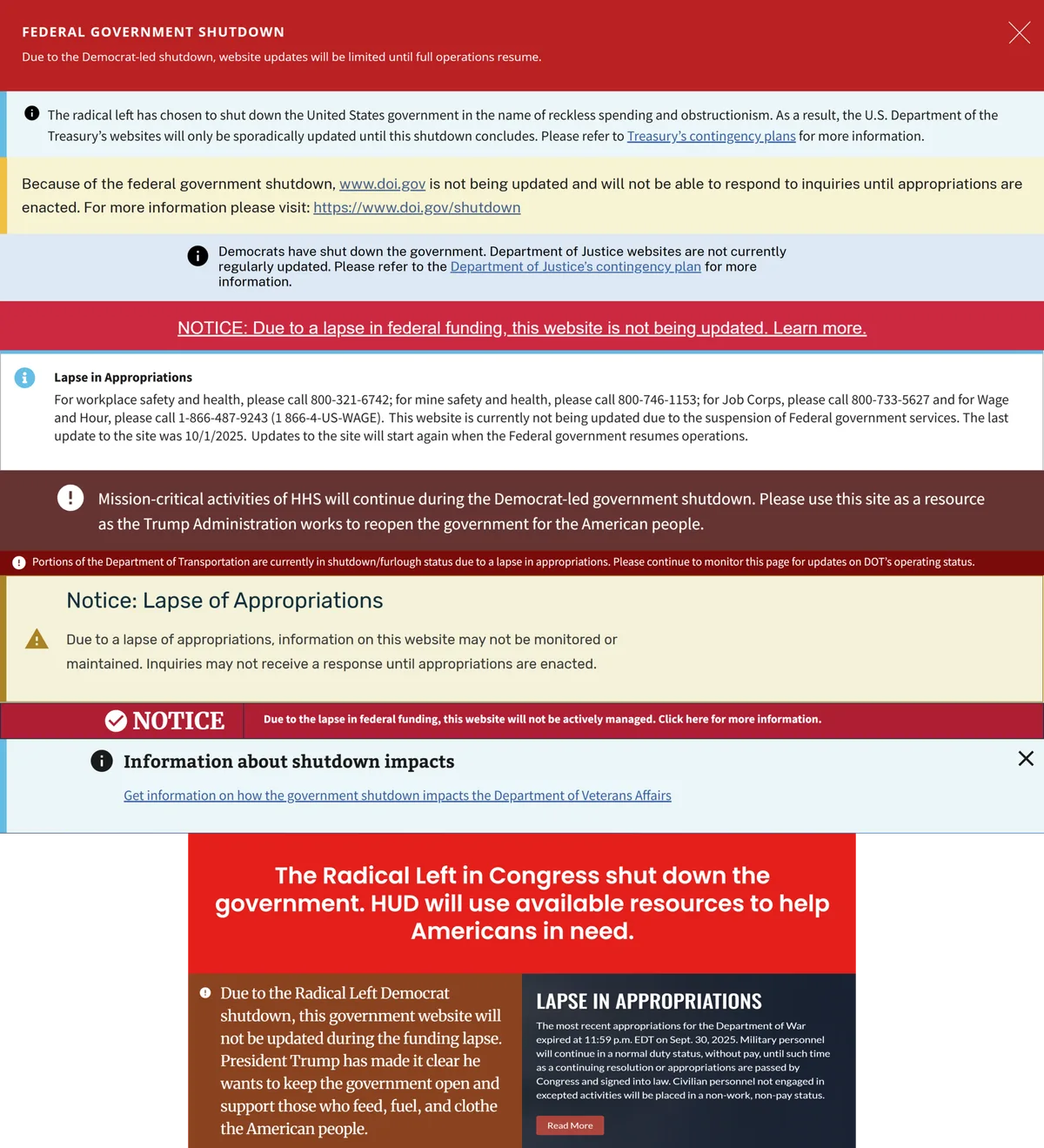
What happens in a government shutdown? When the 12 annual appropriations bills (or a continuing resolution keeping them alive) expire without renewal, agencies may obligate no new money except where law authorizes — and the Anti-Deficiency Act, 31 U.S.C. § 1341, criminalizes spending in excess or advance of an appropriation, so agencies execute contingency plans that furlough non-essential staff and keep only «excepted» activities running: those funded outside appropriations, those protecting life and property, or those whose interruption would violate law. In the record 35-day shutdown of December 2018–January 2019, roughly 800,000 employees were affected — about 380,000 furloughed, the rest working unpaid, per official shutdown-plan documents collected by the Senate.
How does the CR bridge work?
A continuing resolution funds government at a rate, usually the prior year's level, for a set period — days to months — often with «anomalies», specific exceptions negotiated for programs that cannot run at flat funding (new starts, expiring authorities). CRs preserve the status quo by design, which is why they frustrate both appropriators and agencies: no new program may start, no procurement cycle may ramp, and the obligation rate locks. The appropriations calendar starts October 1; every fiscal year since 1977 has had at least some gap covered by CRs, per Congressional Research Service compilations.
Who keeps working?
- Exempt: positions funded by permanent or multi-year authority — U.S. Postal Service operations, mandatory entitlement benefits like Social Security checks, and user-fee-funded activities.
- Excepted: military duty, law enforcement, air-traffic control, disaster response, and medical care — activities where suspension would imminently threaten life or property.
- Furloughed: everything discretionary: permitting and environmental reviews, loans and grants processing, most inspections not tied to imminent danger, park services.
What does a shutdown do to the machinery?
Administratively, the effects compound: federal contractors' payments pause (work performed under lapsed funds stops), grant reimbursements to states and universities queue, visa and passport processing slows, and economic statistics — the Census Bureau's surveys — suspend, delaying the data the Federal Reserve and markets rely on, as happened to months of 2018–2019 data releases. The Government Accountability Office estimated the 2019 shutdown cost the economy roughly $11 billion in lost output, about $3 billion of it permanently.
How do shutdowns end?
Only by enacted appropriations — a CR for days or the full-year «omnibus» package. Back pay for furloughed federal employees has been guaranteed by statute since 2019 (the Government Employee Fair Treatment Act), converting the wage loss into a delayed-payment loan employees did not choose. Contractors have no such guarantee.
Why the debt limit is a different crisis
A shutdown is failure to spend appropriated money; the debt limit is refusal to borrow for money already spent. The two are routinely confused and occasionally linked in negotiations, but their mechanics — and their consequences — are entirely separate, a distinction this publication covers in detail elsewhere.
FAQ
Do Social Security checks stop in a shutdown?
No — mandatory benefits continue; the processing of new claims and some services slows.
Do federal employees get paid for furlough time?
Yes, retroactively, under the 2019 Government Employee Fair Treatment Act; contractors generally do not.
What is an «anomaly» in a CR?
A negotiated exception letting a specific program deviate from prior-year funding levels during the CR period.