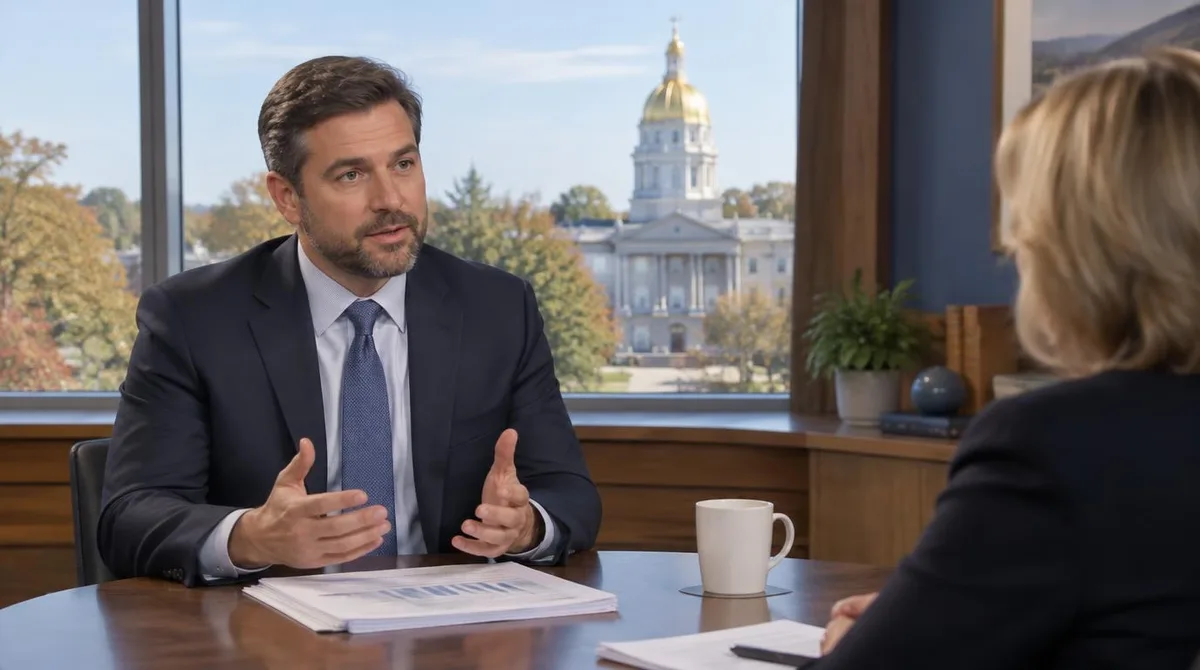
What actually happened in New Hampshire this week? According to WMUR, the station's "NH's Business" program aired a segment on public policy and the state budget, hosted by Fred Kocher, with Gene Martin, the executive director of the New Hampshire Fiscal Policy Institute, as the guest. The segment was posted November 1, 2026.
That pairing is the story. A state budget discussion did not stay inside a committee room or a fiscal office. It went to an audience of business owners and operators, on the program they already watch. When a fiscal policy institute's director sits down with a business-oriented host, the two audiences that most need to understand each other — the people who write budget analysis and the people who live under the tax and spending rules — end up in the same conversation.
So what does it mean, and why should readers outside New Hampshire care? The sourcing here is thin: the retrieved report confirms the segment, the participants, the topic and the date, and nothing more about what was said. What the facts do support is a reading of the format itself, and the format carries information.
Who is talking, and what does each seat represent?
According to WMUR, the guest runs the New Hampshire Fiscal Policy Institute. An institute director on a business program is not a spokesperson for government, and not a partisan officeholder. It is a think-tank voice — someone whose job is to analyze public policy and the state budget — placed in front of an audience whose decisions, hiring and investment plans are shaped by those same policies.
The host's seat matters too. "NH's Business" is, by its title and placement, a program aimed at the state's business community. Putting a budget analyst across from a business host signals that the state budget is being treated as a business story, not only a government story. That framing choice is itself a fact about how the topic is being positioned in New Hampshire's public conversation.
Why would a business audience want the state budget explained?
Because a state budget is the document where policy becomes operational. Decisions about what a state funds, and what it does not, reach businesses through the rules, services and costs that follow. A segment that explains public policy and the state budget to a business audience is, in effect, translating a legislative document into terms that affect payroll and planning.
Readers who want the mechanics behind that translation can look at how states price legislation before it passes, in Fiscal Notes vs. CBO Scores: How States Price a Bill Before It Passes. The same logic applies on the analysis side: understanding what a fiscal institute does starts with understanding What Is Policy Analysis? The Methods Behind the Recommendations. For related coverage, see Fiscal Notes vs. CBO Scores: How States Price a Bill Before It Passes.
What should a careful reader take from this segment?
Three things, and only three things, that the evidence supports.
- The topic is live. A program dedicated a segment to New Hampshire public policy and the state budget on November 1, 2026, which tells you the subject is considered timely for that audience.
- The messenger is analytical, not official. The guest represents a fiscal policy institute, so the discussion is framed around analysis of the budget rather than around a department's own account of it.
- The audience is economic. The segment ran on a business program, which means the budget was presented as something with consequences for firms, not only for agencies.
Beyond those points, the retrieved reporting does not say what specific policies, figures or disagreements came up in the conversation. Readers should be wary of any summary that fills that gap from elsewhere. The honest reading stops at the format and the participants.
Where does the story go next?
The useful next step for any reader is to go back to the primary materials: the segment itself, and the budget documents it discusses. Coverage of a budget conversation is a pointer, not a substitute. When the underlying figures, deadlines and line items surface in retrievable form, the analysis can move from what the conversation signals to what the budget actually does — and the gap between those two is exactly where state policy coverage earns its keep.
For readers tracking how such conversations connect to formal process, the pathway from a proposal to enforceable rules runs through the legislature, as explained in How a Bill Becomes a Law: The Committee Gatekeepers. And for the broader context of how budget and policy stories fit together on this site, start with the policy section, or follow the economic angle in business news.