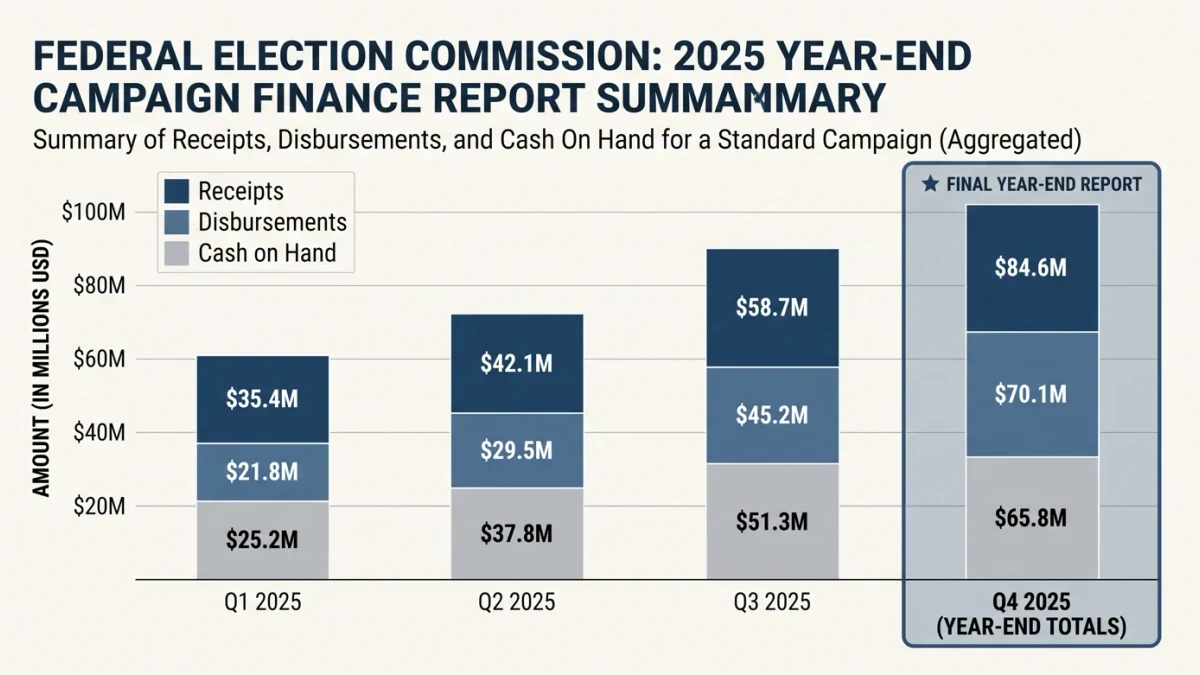
The year-end reports covering all of 2025 fundraising by federal campaign committees, parties and PACs are due to the Federal Election Commission on February 2, 2026 — the statutory January 31 deadline falling on a Saturday rolls to the next business day under FEC filing rules. The filings will show, for every House and Senate campaign that filed in 2025, total receipts, disbursements, cash on hand and debts as of December 31, 2025, posted to the FEC's public candidate database.
What is actually in a year-end report?
Form 3 committees report contributions itemized by donor — name, city, employer and occupation required for any contribution over $200 in an election cycle — plus unitemized small-dollar totals lumped together. Independent-expenditure-only committees file separately, and national party committees' three accounts (operating, conventions, buildings, plus the legal-and-accounting and headquarters accounts created by the 2014 Cromnibus) each report line by line. The year-end report matters more than any quarterly snapshot: it is the first full-cycle picture of which candidates entered 2026 with money banked versus money spent.
Which numbers carry real information?
- Cash on hand minus debts: the only figure that predicts a primary media campaign.
- Itemized vs. unitemized ratio: signals small-donor breadth versus big-donor concentration, per the FEC's itemization threshold.
- Burn rate: disbursements as a share of receipts — early-cycle burn above 80 percent usually means a consultant-heavy operation.
- Transfers from national party committees: legal, disclosed, and a map of where Washington thinks the races are.
What happens after the deadline?
Committees file electronically and the data goes public within minutes to the FEC's searchable systems; the Commission's reports-analysis division then reviews for completeness and can initiate enforcement matters — which are public only after a finding of reason to believe a violation occurred. Watch-dashboards run by the FEC itself, including the campaign finance data portal, will have the full 2025 cycle tallies within days of the February 2 deadline.
The procedural consequence
Under the reporting calendar, the next mandatory disclosure — the April quarterly covering January through March — arrives after most filing deadlines and several primaries. The year-end report is therefore the last full financial picture voters and journalists get before many 2026 fields are fixed; candidates know this, which is why the December 31 books get special year-end attention from treasurers.
FAQ
Why February 2 instead of January 31?
FEC deadlines falling on weekends or federal holidays roll to the next business day; January 31, 2026 is a Saturday.
Are small donations itemized?
Individually no — only contributions over $200 per person per cycle must be itemized with donor details; smaller amounts are reported as unitemized totals.
Can campaigns correct filings?
Yes, amended reports are routine and public; the FEC flags material changes in its data releases.