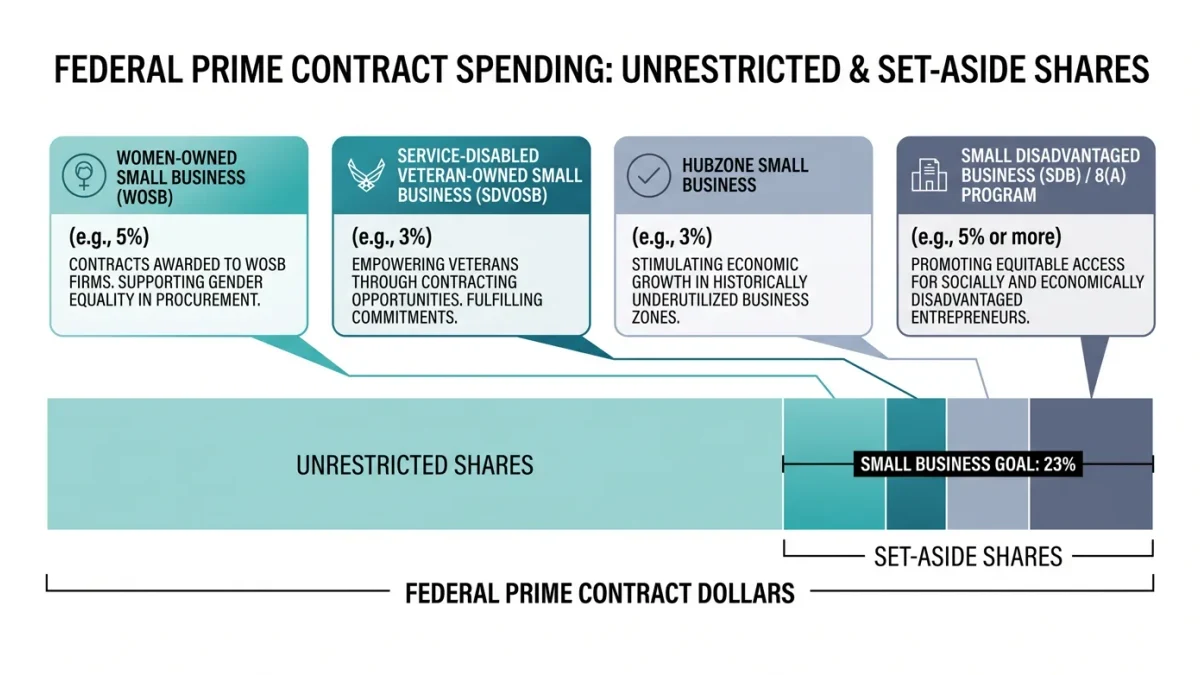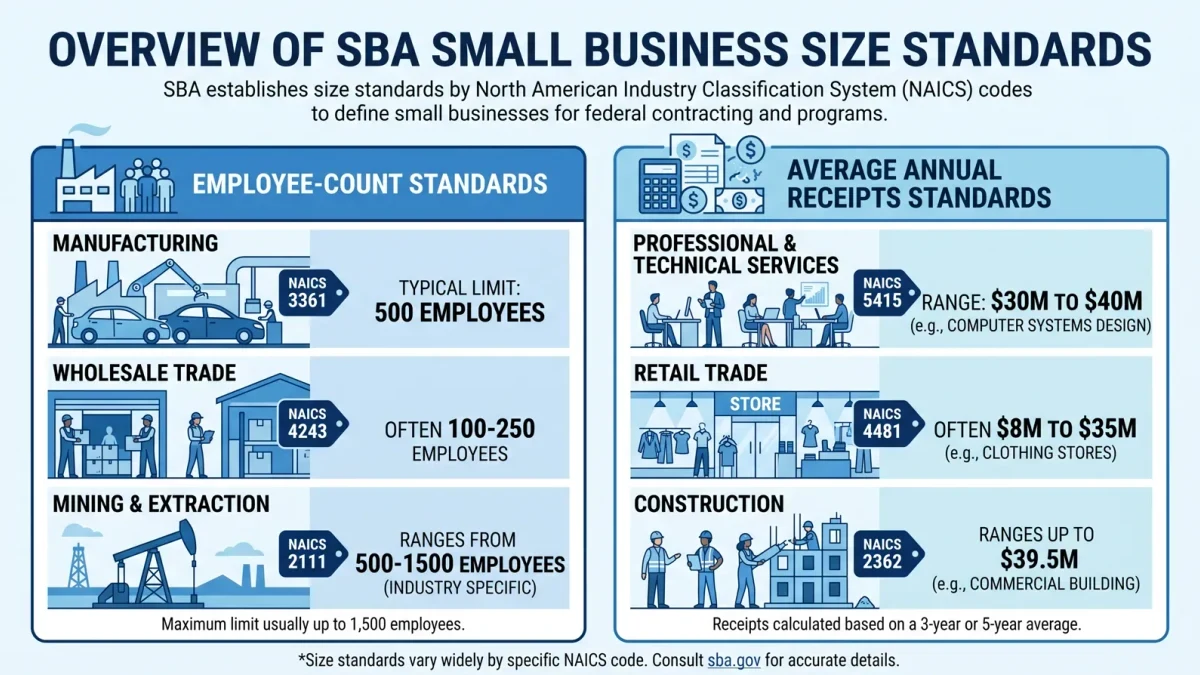
How does a small business win federal contracts? Through the Small Business Administration's contracting programs: agencies must set aside suitable procurements for small businesses — by statute, a goal of 23 percent of prime contract dollars government-wide, with sub-goals for specific categories — and firms qualify by registering in SAM.gov, meeting SBA size standards (employees or average annual receipts varying by industry code), and self-certifying or seeking formal certification for special categories. The federal government obligated roughly $780 billion in contracts in fiscal 2024, awarding a record share to small businesses, per the Federal Procurement Data System's official statistics.
What are the set-aside programs?
- Small business set-asides: contracts over the simplified acquisition threshold reserved when there is a reasonable expectation of offers from small firms — the workhorse.
- 8(a) Business Development: firms owned by socially and economically disadvantaged individuals, admitted through a formal SBA certification, with sole-source authority up to statutory ceilings.
- HUBZone: firms in historically underutilized business zones, certified by SBA, with a 3-percent goal.
- Service-Disabled Veteran-Owned (SDVOSB) and Women-Owned Small Business (WOSB/Economically Disadvantaged WOSB): certified — SDVOSB and WOSB certification now runs through SBA — with their own goals and set-aside lanes.
How does the process actually run?
Opportunities post on SAM.gov with a NAICS code determining the size standard; contracts below $250,000 (the simplified acquisition threshold) get simplified procedures; the Rule of Two requires a set-aside when two or more small firms will offer at fair prices. Bid protests — at the agency, the Government Accountability Office (fast, free) or the Court of Federal Claims — police award decisions. Subcontracting adds a second lane: large primes must submit subcontracting plans, and small firms often enter the ecosystem as subs before winning primes.
Where do small firms stumble?
Three recurring spots. Registration hygiene: an expired SAM registration voids bids — the single most common self-inflicted loss. Size and affiliation: SBA's affiliation rules aggregate a small firm with its investors and partners, and size protests can strip awards retroactively. Past-performance Catch-22s: mitigated by the certificates of competency process and by teaming and joint-venture rules that let small firms borrow mentor experience under SBA-approved mentor-protégé agreements.
What changes with administrations
Category management, consolidation of contracts into huge vehicles, and skepticism toward categories themselves have alternately compressed and expanded small-business share — the debate is chronic, statutory goals notwithstanding. Firms planning 2026–2027 growth should watch the SBA's regulatory agenda and the annual scorecards: the government small-business goaling scorecard, published yearly, shows each agency's actual share, which tells vendors where the appetite is.
Political Digest publishes information, not business or legal advice.
FAQ
What is the Rule of Two?
A contracting officer must set aside a contract for small businesses when two or more are expected to offer at fair market price.
How is small defined?
By SBA size standards tied to NAICS codes — employee counts or average annual receipts; affiliation with other firms can change the answer.
What is SAM.gov for?
The single registration for doing business with the government — the source of opportunity notices, and a lapsed registration voids eligibility.