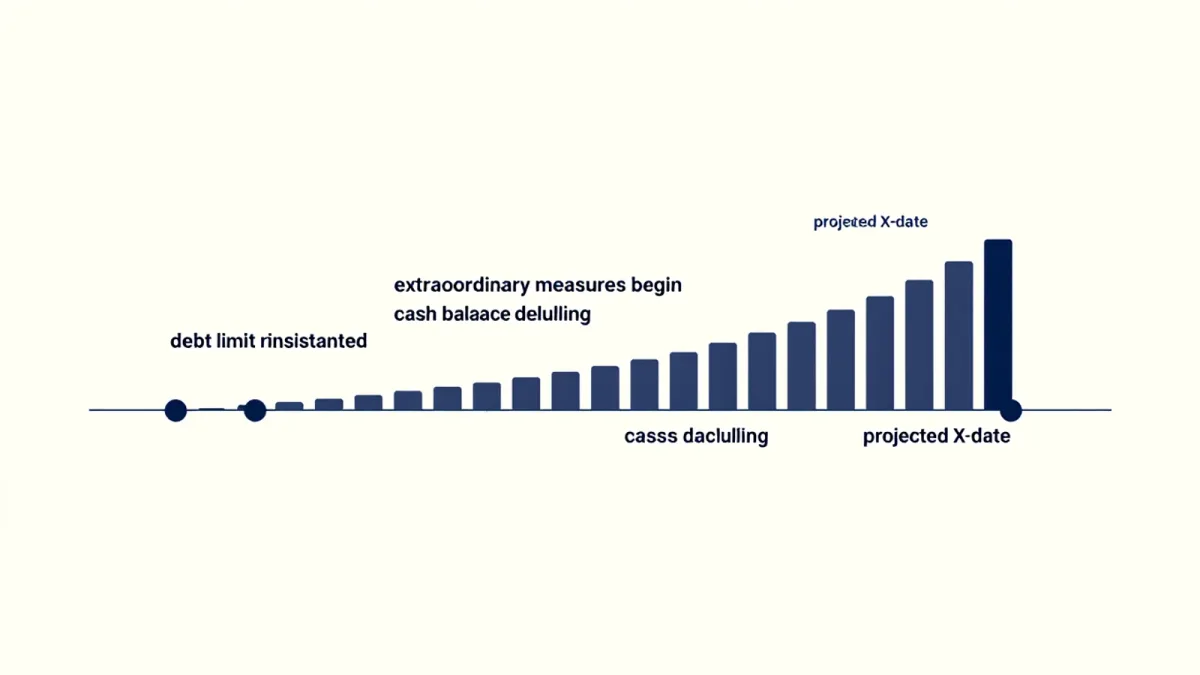
What happens when the U.S. hits the debt limit? The Treasury can no longer borrow above the statutory cap, so it suspends investments in federal employee retirement funds and uses other accounting tools — called extraordinary measures — to keep paying bills in full, until those tools are exhausted on the X-date, after which Treasury can fund obligations only from incoming tax receipts, which cover roughly 80 percent of spending, per Treasury's own debt-limit letters to Congress. Equity and credit markets begin repricing political risk weeks before the X-date, which is why the mechanics matter to business readers.
What exactly is the statutory debt limit?
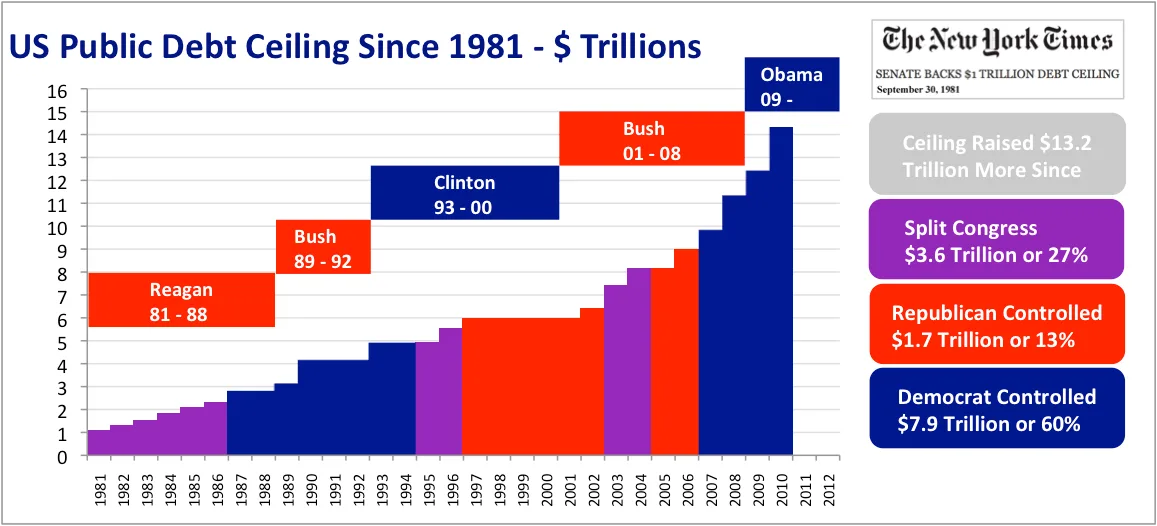
It is a ceiling, set in law, on the total face value of federal borrowing. Congress created the modern aggregate limit in 1939 and has raised or revised it more than 100 times since, including suspensions — time-limited periods with no cap — in every budget deal since 2013, per the Congressional Research Service. Crucially, raising the limit authorizes borrowing for spending Congress already enacted; it is a payment authorization, not a new-spending authorization.
What are extraordinary measures?
Upon hitting the cap, Treasury declares a «debt issuance suspension period» and stops issuing new securities to the Civil Service Retirement and Disability Fund, the G Fund of the Thrift Savings Plan, and the Exchange Stabilization Fund, while redeeming existing securities to create headroom. The funds are made whole afterward by statute — federal employees lose nothing in the end. These measures bought roughly four to six months of headroom in recent episodes, depending on tax season cash flow.
How do markets behave as the X-date approaches?
The stress shows up first in short-dated Treasury bills maturing near the X-date, whose yields rise as investors demand a premium for payment risk — the pattern seen in 2011, 2013, 2023 and 2025 standoffs, with the 2011 episode prompting Standard & Poor's to downgrade the U.S. rating from AAA in August 2011. Money-market funds rotate away from vulnerable maturities; corporate treasuries stretch cash buffers. Past the X-date without resolution, prioritization of payments — paying some obligations and not others — is the unread scenario: Treasury has said its systems are not built to pick winners among obligations, and most legal analysts doubt the authority exists.
Why do standoffs keep recurring?
Because the limit must be raised by regular legislation, it became leverage in budget negotiations — usually producing a deal within days of the projected X-date, as in June 2023's Fiscal Responsibility Act and the July 2025 suspension enacted alongside that year's tax-and-spending package. Each resolution resets the clock for roughly two years under suspension structures. The economic damage is largely from proximity: the Bipartisan Policy Center, which projects X-dates, estimates that even near-misses raise borrowing costs.
What should businesses watch?
- Treasury's daily and monthly statements: general fund cash balances falling toward the low hundreds of billions signal approach.
- Quarterly refunding announcements, where Treasury reshapes bill issuance around limit windows.
- Bill-curve kinks: one or two maturities trading cheap to neighbors mark where the market puts the X-date.
- CDS spreads on U.S. sovereign risk — thin but directionally honest.
FAQ
Does hitting the debt limit mean default?
Only if the X-date passes without action. Extraordinary measures and cash receipts keep payments flowing before that point; after it, Treasury could miss obligations unless Congress acts.
What is the difference between raising and suspending?
Raising sets a new dollar cap; suspending removes the cap until a fixed date, then resets it to accommodate borrowing done meanwhile.
Why can't Treasury just mint coins or invoke the 14th Amendment?
Both are legally untested workarounds that presidents have declined to rely on, precisely because a court challenge could add chaos on top of the payment risk.