What does early voting data actually measure? State and county election offices publish daily counts of ballots returned — by mail, early in person, and, where party registration exists, by registrants' party — and those cumulative figures tell you who has banked a vote, not which candidate leads. In 2024, more than 80 million votes were cast before Election Day nationally, roughly half the total, per the U.S. Election Assistance Commission's post-election reports and state canvass statistics; yet the nightly «early vote leads» that dominated coverage tracked turnout composition, not outcomes — a distinction with a documented track record of misleading both parties.
What the data genuinely shows
- Turnout composition: mail versus early-in-person versus Election Day share — a mechanical fact about administration.
- Registration party (in ~30 states): the registrant's party, not the ballot's destination; crossover and independent voting make these percentages loose at best.
- First-time and low-propensity voters: when states report voter-history files, genuinely new participants are visible — the most analytically valuable cut.
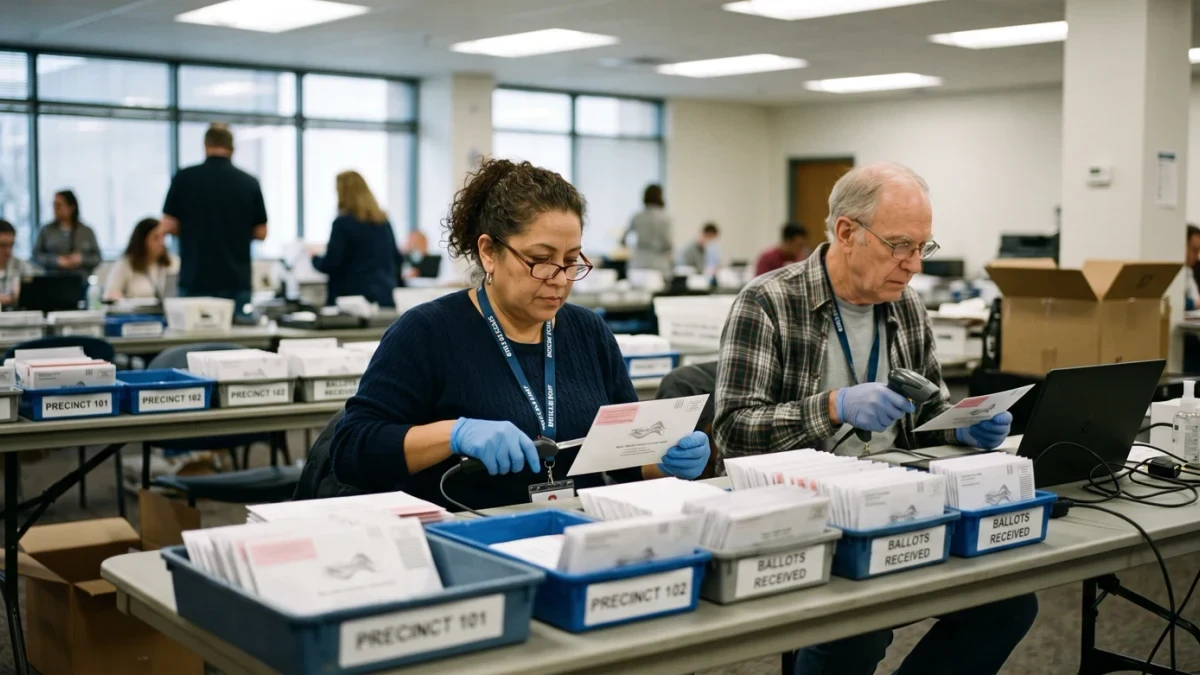
- Ballot processing pace: how quickly returns are verified and counted — a predictor of how long results will take.
The three recurring reading errors
Error one: party-registration leads equal candidate leads. A Republican-registration edge in returned mail ballots does not mean Republican votes; Florida's registration edge has coincided with Democratic presidential wins in the same electorate's other races, and unaffiliated voters — now the fastest-growing registration category in most party-registration states — are invisible in the party cut.
Error two: treating composition change as enthusiasm change. When a party's voters shift from Election Day to early voting — as happened repeatedly after 2020, when one party's leaders disparaged mail voting and its electorate moved in person — the early totals «collapse» with no change in final support. Composition migrates; it does not disappear.
Error three: extrapolating uncalled ballots. The election-day universe differs systematically from the early universe in age, race and party; projecting one onto the other needs a model, and models disagree.
What analysts who use this data well actually do
They benchmark against the same jurisdiction's same-day figures in the last comparable election; they watch share of expected total turnout rather than raw counts; they use voter-history files to split «new» voters from cannibalized ones; and they treat the returned-ballot count as a floor for final turnout, not a forecast. Academic projects like the MIT Election Data and Science Lab and the Stanford-MIT Healthy Elections tracker publish exactly these comparisons — the responsible version of the same nightly data.
Why 2026 will test the habit again
Midterm electorates are older and smaller, mail-voting rules have been re-tightened in several states since 2020 (drop-box limits, ID for mail ballots in new laws), and each rule change shifts composition in ways that look like opinion change in raw counts. The professional question for readers of nightly early-vote dashboards is always the same: compared with what baseline? Any early-voting story that lacks the last-comparable-election comparison is not analysis; it is a scoreboard with the score missing.
FAQ
Do most states report party registration of early voters?
About 30 states register voters by party and can report it; the rest cannot, and «party» figures for them are modeled, not observed.
Can you tell who is winning from early voting?
No — only who has voted. Ballot choices are secret until counting begins under each state's schedule.
Why do some states count mail ballots late?
State laws set processing windows; some permit counting before Election Day, others not until it, which delays tallies without any administrative failure.