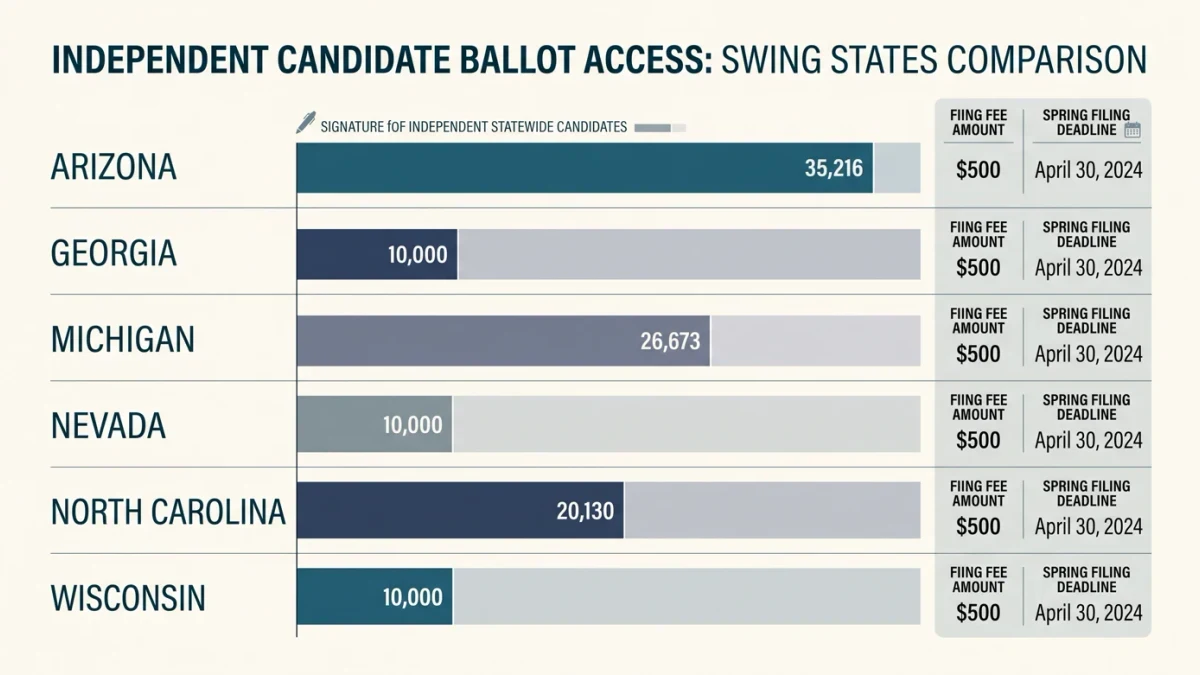
Who gets on the ballot in a swing state? Candidates for statewide office in the most competitive states must clear signature requirements ranging from a few thousand names to well over ten thousand, pay filing fees that reach five figures in some states, and do it all by deadlines that fall six to ten months before the general election — meaning the 2026 field in Pennsylvania, Georgia, Arizona, Wisconsin, Nevada and Michigan was largely locked before summer. These rules, set by state law and administered by secretaries of state, decide the menu of choices before a single campaign ad airs.
Why does ballot access matter more in swing states?
In safely partisan states, a tough access hurdle rarely changes outcomes because one party dominates anyway. In swing states, a third-party or independent candidate kept off the ballot, or a major-party nominee who botched signatures, can shift a race decided by margins under one percentage point. In 2020, four states were decided by less than a percentage point — Georgia by about 0.24 percent, per the certified results published by each state's election authority — so access mechanics operate at precisely the scale of competitive margins.
How do signature requirements differ across the battlegrounds?
Requirements for independent or new-party candidates vary widely and are typically far higher than for major-party candidates, who qualify through primaries. Pennsylvania requires independents for statewide office to gather signatures equal to 2 percent of the highest vote cast in the previous statewide election — a threshold that produced the five-figure demands litigated in 2020 ballot-access cases decided during the COVID-19 pandemic. Arizona requires nominees of unrecognized parties to gather signatures equal to a percentage of registered independents. Michigan and Wisconsin use lower fixed numbers but impose strict petition formats where a wrong-size line can void a sheet.
What role do challenge and protest periods play?
After filing, states open a window — often one to two weeks — in which any voter or party may challenge signatures. Challenges focus on mismatched addresses, circulator errors and duplicate names. Because the burden of proof sits with the candidate, a sufficiently aggressive challenge can knock out a petition drive even where most signatures are valid. Courts get involved quickly: election cases are heard on expedited schedules, and under the Purcell principle — applied by the Supreme Court repeatedly since 2006 — federal judges are wary of changing election rules close to an election, which front-loads all access disputes into the first half of the election year.
Do filing fees create a separate barrier?
Yes, and a material one. Florida's candidate filing fee for statewide office is set at a percentage of the annual salary of the office sought — several thousand dollars — while Georgia charges 3 percent of the salary, close to $3,500 for U.S. Senate. States must offer an alternative: the Supreme Court held in Bullock v. Carter (1972) and Lubin v. Panish (1974) that flat fees without a signature-substitute option violate equal protection. The result is a two-track system where well-funded campaigns pay and grassroots campaigns gather.
What happens when a major party misses its own deadline?
The consequences are unforgiving. State law typically fixes both a filing deadline and a substitution rule for withdrawn candidates. In 2002, New Jersey's Democratic U.S. Senate replacement made national news when the party missed the 51-day deadline and the state supreme court allowed the swap; in 2020, several states litigated whether a candidate who had qualified could be replaced after announcing withdrawal, with South Carolina's law — which permits substitution after the deadline — contrasted with stricter states. The lesson each cycle: deadlines have teeth, and courts are reluctant to rescue parties from their own calendar errors.
Where is the 2026 pressure point?
Governor's races and U.S. Senate seats in the battlegrounds will draw crowded fields, and each crowded field multiplies petition challenges. Watch three documents in each state: the secretary of state's candidate guide (published each cycle with exact signature counts), the challenge-period rules, and the substitution statutes. Those three texts, more than any poll, determine which names reach the November 2026 ballot.
Political Digest publishes information, not legal advice; candidates should consult state election authorities for current requirements.
FAQ
Why are independent signature requirements higher?
State laws justify higher thresholds as a show of support for candidates who skipped a party primary; courts allow them but strike down totals so high they exclude candidates from the ballot entirely.
What is the Purcell principle?
The practice, derived from a 2006 Supreme Court case, of federal courts declining to change election rules shortly before an election because late changes confuse voters and administrators.
Can a challenge remove a major-party nominee?
Only for procedural defects in the nominating process — petition errors or missed deadlines — not for platform or campaign conduct, and substitution rules in most states then apply.