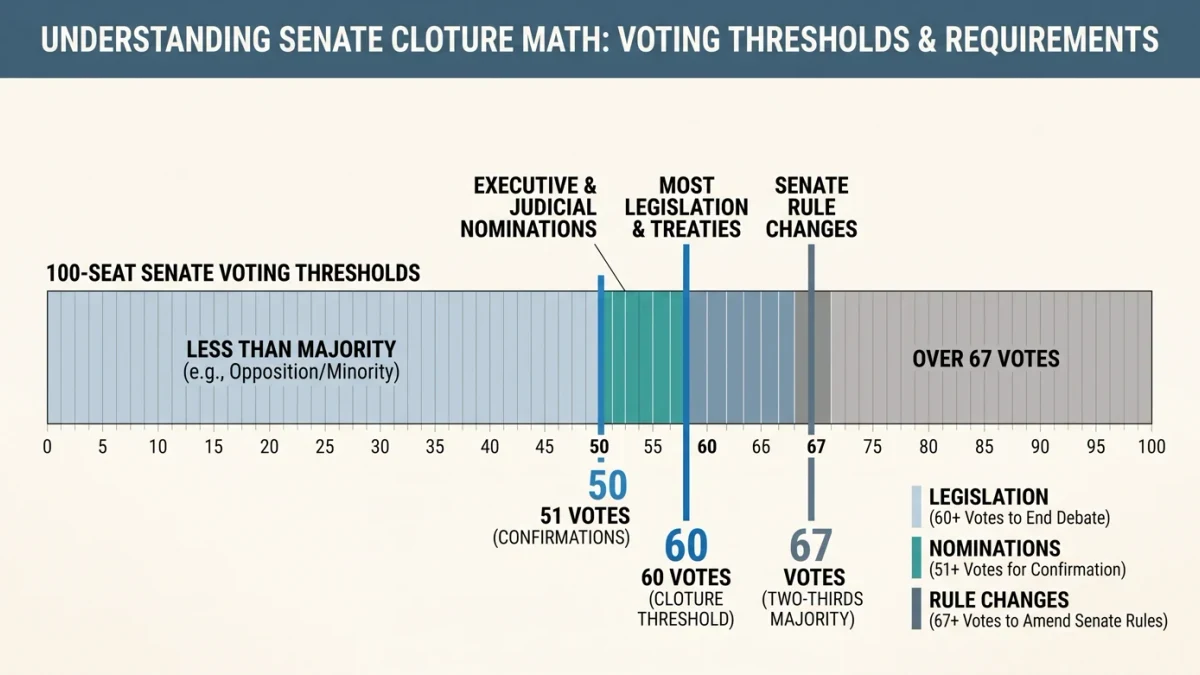
Why does the Senate filibuster still exist? Because Rule XXII's requirement of 60 votes for cloture gives the minority of the moment a veto over ordinary legislation, and each party, when in the minority, values that veto more than it resents it while in the majority — a stability that has survived every reform push since the modern cloture rule's adoption in 1917. Cloture motions, once rare (filed single-digit times per Congress into the 1960s), now run well over a hundred per two-year Congress, per the Senate's own cloture statistics — the clearest quantitative measure of the chamber's transformation into a 60-vote body.
What is actually being debated when people debate the filibuster?
Three different things get called «filibuster reform.» First, eliminating Rule XXII by simple-majority precedent — the «nuclear option» used for nominations in 2013 and 2017, which Senate Republicans formally proposed for legislation in 2025 with President Trump's public backing and did not adopt. Second, carve-outs: a precedent making one subject — voting rights, debt limit, immigration — majority-only. Carve-outs erode the rule piecewise; the 2013 nominations change began as an exception and, by 2017, consumed the Supreme Court itself. Third, process changes short of majority passage: the «talking filibuster» proposals, which would raise the minority's cost without removing its power.
What has already been carved out?
- Budget reconciliation: 20-hour caps, simple majority — by statute since 1974, not by precedent.
- Trade promotion authority: guaranteed up-or-down votes under TPA statutes.
- Executive and judicial nominations: simple-majority cloture by precedent, 2013 (sub-cabinet and below-court) and 2017 (Supreme Court).
Why do majorities keep sparing it?
Raw alternation. The Senate has changed hands or come within two seats of it in most cycles since 2000; a majority that kills the legislative filibuster hands the next majority a legislative assembly line. Individual senators from swing states also derive leverage — their 60th vote is worth more than their 50th — which is why the 2025 Republican majority, publicly pressured to go nuclear for its own agenda, did not: votes were lacking among members who had defended the rule under the previous majority, per roll-call coverage of the conference deliberations. Both parties' positions have flipped in sequence; the rule's defenders in each cycle are simply whoever most recently tasted the minority.
What would actually happen if it died?
Legislation would track the House's majority-rule rhythm: bigger swings in policy each alternation, less incentive to negotiate across the aisle, and a stronger premium on unified control. Because reconciliation already carries fiscal policy, what the filibuster chiefly protects now is non-fiscal law — immigration, guns, voting procedure, most criminal and regulatory statutes. Its abolition would move those subjects onto the every-two-years pendulum that tax policy already rides.
Is reform possible without abolition?
The Senate changed Rule XXII itself in 1959 and 1975 — the latter lowering cloture from two-thirds present to three-fifths sworn — each time through pressure and negotiation, not unilateral precedent. The lesson both parties have drawn: formal rule changes by two-thirds endure better than bare-majority precedents, which the next majority can re-run in reverse.
FAQ
Can the vice president just rule the filibuster unconstitutional?
A presiding officer could attempt it, but sustaining the ruling takes a simple-majority vote — the nuclear option — which is exactly what majorities have declined to muster for legislation.
What is a talking filibuster?
A proposed variant requiring objecting senators to hold the floor continuously; it raises visibility and stamina costs but leaves the 60-vote threshold intact.
How often is cloture used now?
Routinely: cloture motions have exceeded one hundred per Congress in recent sessions, versus single digits before 1970, per Senate statistics.