What does a poll's margin of error actually mean? For a typical survey of 1,000 likely voters, the ±3 percent margin of error applies to each percentage separately at 95 percent confidence — meaning a 48-to-44 lead has a true gap that could plausibly range from a 10-point lead to a 2-point deficit once both candidates' uncertainties combine. The American Association for Public Opinion Research's disclosure standards exist precisely because that arithmetic, plus a poll's weighting and screen, determines whether a «lead» is news. This publication carries polls only with pollster, dates, sample and margin — and never as the story's substance.
Five ways sound polls get misread
1. The double-margin trap. Differences between candidates (or between polls) carry roughly twice the stated error. A lead inside about five points at ±3 is not distinguishable from a tie; calling it a «lead» is a formatting choice, not a finding.
2. Subgroup mirages. The «Republicans under 35» cell with 120 respondents carries an error near ±9; crosstab narratives built on cells that small are noise arranged as a storyline.
3. Likely-voter screens. Each pollster models who will vote differently — past turnout, stated intention, registration recency. Screens explain much of the persistent house-effect differences between pollsters surveying the same race.
4. Weighting as invisible opinion. Pollsters adjust samples to match population targets — education, age, race, sometimes recalled 2020 or 2024 vote. Different choices here produce different results from identical raw data; AAPOR's transparency initiative asks pollsters to disclose them for exactly this reason.
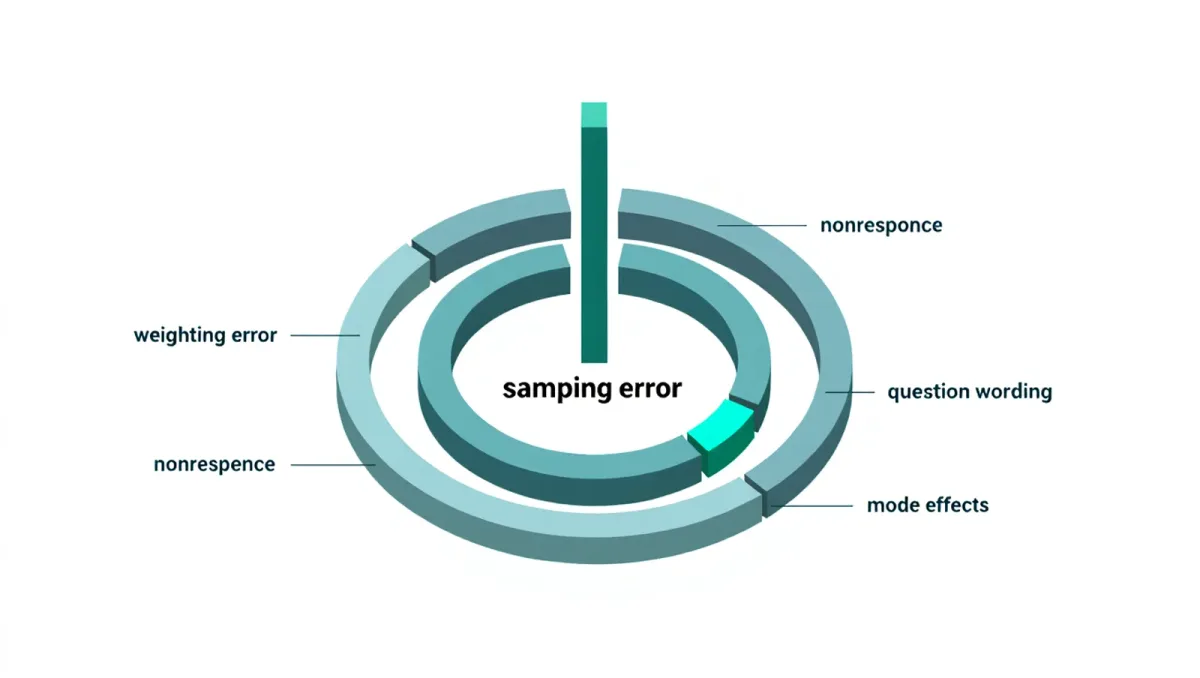
5. Averages hide dispersion. Aggregates smooth both error and methodology: when individual polls scatter across a wider band than their stated margins imply — as they did nationally in 2016 and 2020, and in some states in 2024 — the real uncertainty exceeds any single poll's ±3.
What the 2020s changed
Response rates have fallen under 5 percent for telephone polls, pushing the industry to mixed modes: online panels, text-to-web, mail, and probabilistic address-based sampling. Gold-standard probability panels — of the kind Pew Research Center and AP-NORC run — show that careful probability sampling still works, but the average campaign poll now leans on nonprobability samples adjusted by weighting, which transfers error from the sampling step to the modeling step. The practical consequence for readers: two good-faith polls can disagree by six points, both telling the truth about their own method.
A reader's checklist
- Who conducted and paid for it; is the pollster AAPOR-transparent?
- Dates in the field — a week-old poll predates whatever it is being cited as reacting to.
- Sample: registered vs. likely voters; n for the subgroup being discussed.
- Exact question wording, especially on ballots with multiple candidates.
- House effects: how this pollster leaned in recent cycles.
FAQ
What margin of error applies to a candidate's lead?
Roughly double the poll's stated margin — a lead smaller than that is statistically indistinguishable from a tie.
Are online polls less accurate?
Not inherently; methodology and weighting discipline matter more than mode, per AAPOR's post-election studies.
Why did 2020 state polls miss?
Post-hoc studies pointed to differential nonresponse — Trump-leaning voters participating less — compounded by timing and weighting choices, not fraud or one-sided sampling alone.