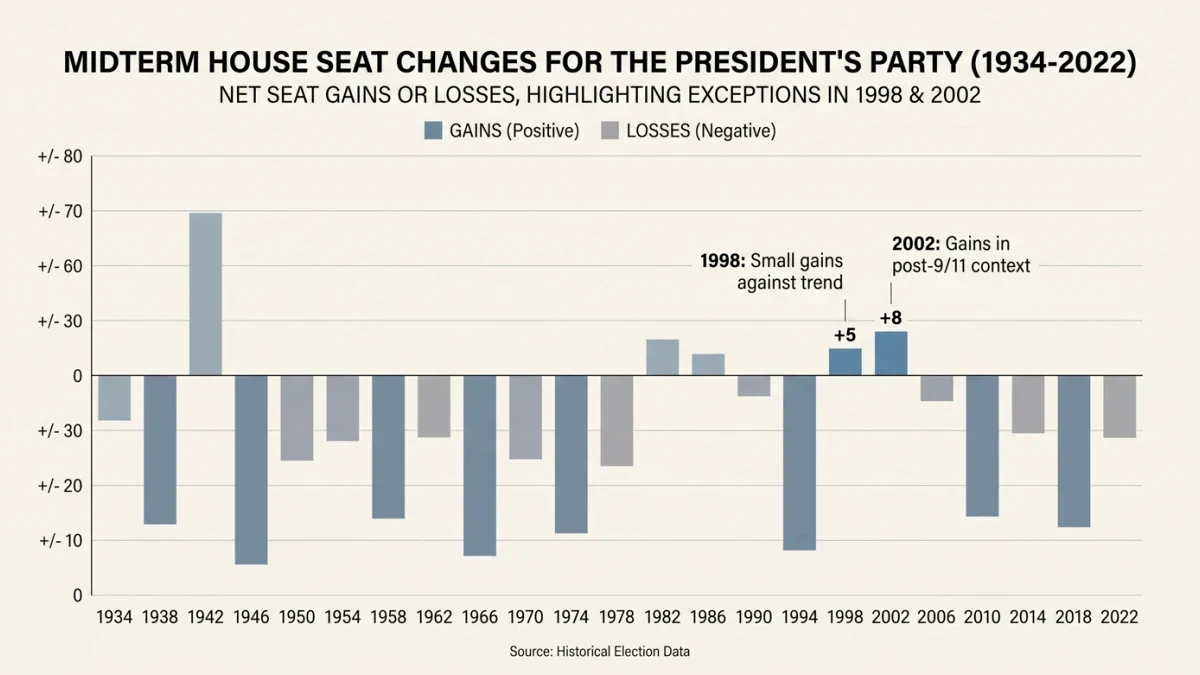
What usually happens in a midterm? The president's party has lost House seats in 18 of the 23 midterms since 1934, averaging roughly 26 seats, per historical results compiled by the Clerk of the House — and it has lost Senate seats in most, though the Senate's staggered map means each cycle's exposure depends on which class is up. The exceptions are the lesson: 1998 (Democrats gained seats amid impeachment), 2002 (Republicans gained post-September 11) and 2022 (Democrats narrowly held the Senate and lost only single-digit House seats). Each exception coincided with unusually high presidential approval or an unusually favorable issue environment — and two of the three produced small deviations, not reversals.
Why does the president's party lose seats?
Three mechanisms recur. Turnout composition: midterm electorates are older, whiter and higher-income, which historically penalized the party of the president regardless of which party it was. Thermostatic reaction: voters anchor on the government they have, and off-year elections are where dissatisfaction expresses itself cheapest. And the reversion problem: the president's party just won, often at a high-water mark, so the seats it defends are the marginal ones it gained — the natural regression any winner faces.
What changed after 2018?
The relationship between presidential approval and seat losses has flattened. In 2022, with approval in the low 40s, the president's party lost only nine House seats — the second-smallest loss for a first-term president's party since 1934 — because seats had sorted: fewer districts vote for one party's House candidate and the other's presidential candidate. The pool of genuinely marginal seats has shrunk from the 1990s' dozens to today's low twenties, which caps both red waves and blue ones. 2024's results, decided on narrow margins across seven states, continued the pattern: competitive terrain is thinner, and national swings move fewer seats.
What does 2026's Senate map look like through this lens?
The Senate's math is asymmetric by design — two seats per state regardless of population — so the class up in 2026 determines everything. History's guidance here is weak: Senate midterms since 2000 have produced everything from net losses of six to net gains, and analysts on both sides have learned to argue map first, history second.
What about governors and legislatures?
Gubernatorial losses track the president's party less tightly because governors run on state records; state legislative chambers have been swinging hard in both directions since 2018, with the 2022 cycles producing record-tight chamber margins in Pennsylvania, Minnesota and elsewhere. For redistricting-watchers, the 2026 legislative results matter beyond their own terms: the maps drawn after 2030 will be drawn by the legislators elected across this cycle.
FAQ
Has the president's party ever gained House seats in a midterm?
Yes — 1934, 1998 and 2002 are the modern exceptions, each under distinctive conditions.
What was the largest midterm loss?
2010: Democrats lost 63 House seats; 1994 and 2018 round out the modern maxima.
Why did 2022 break the pattern's size?
Seat sorting: fewer competitive districts meant the same national swing translated into far fewer seat changes.